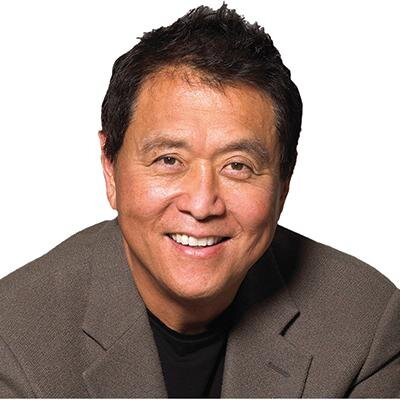
@theRealKiyosaki
The author of Rich Dad Poor Dad — the best-selling personal-finance book of all time — turned one of X's loudest crash-callers. His crypto thesis is simple and unchanging: the dollar is being debased, so own gold, silver and Bitcoin and buy every dip. He posts constantly, with dates, which makes him checkable — and the check is not uniformly kind.
In short. Robert Kiyosaki is a financial author and commentator, not a trader in any conventional sense. He does not chart, does not size positions publicly, and does not exit — his entire method is accumulate hard assets and hold through the crash he is always predicting. In 2026 that meant buying Bitcoin near the February lows and telling followers in June to swap cash for Bitcoin and Ethereum, both of which worked. It also meant a running series of imminent-collapse warnings that have not resolved, and a headline $250,000 Bitcoin target for 2026 that is on track to miss badly — BTC is near $84k with about three months left. Read him as a permanently bullish hard-asset accumulator whose timing calls are noise and whose direction, this window, happened to be right.
Kiyosaki, born in Hilo, Hawaii in 1947, is a former Marine Corps helicopter pilot and businessman who became a global name with Rich Dad Poor Dad (1997), a personal-finance parable that has sold tens of millions of copies and spawned the Rich Dad Company, a franchise of books, seminars, board games and a long-running podcast. His core message predates crypto by a decade: work for assets rather than wages, use debt and tax structure deliberately, and distrust savings held in fiat currency.
Bitcoin slotted neatly into that worldview and he has been a vocal holder since the 2010s, framing it as “people's money” alongside physical gold and silver. What deserves flagging up front is his prediction record. He has forecast an imminent, historic crash more or less continuously since Rich Dad's Prophecy (2013), and he says so himself in the very posts charted below. Press reviews of his calls have put the hit rate at roughly 10% since 2022. His concrete crypto targets have a poor record too: a June 2024 call for $350,000 Bitcoin by August 2024 never came close, and the $250,000 by 2026 target he set in a November 2025 X post — along with a $60,000 Ethereum figure that analysts read as a likely typo — would need Bitcoin to triple from here in under four months. Those calls sit outside this chart's price window, so they are not scored below, but they belong on the record.
Sources: x.com/theRealKiyosaki · youtube.com/@theRichDadChannel · dated third-party coverage
Narrative macro, zero technicals. Kiyosaki's framework is a single thesis repeated for three decades: government debt and central-bank printing destroy the purchasing power of savings, so hold assets that cannot be printed. He calls gold and silver “God's money” and Bitcoin “people's money,” buys mechanically into weakness, and never publishes a stop or a target he intends to trade. There is no chart work, no position sizing and no exit plan — which means his calls cannot really be traded, only agreed or disagreed with. The recurring weakness is timing: the crash is always imminent, the price targets are round and enormous, and neither is falsifiable on any stated deadline.
Structurally, permanently bullish on Bitcoin, gold and silver — and permanently bearish on the dollar and the wider economy. He buys drawdowns by policy, so his bias effectively never changes with price.
Dated statements from Kiyosaki's own X posts and the third-party coverage that quoted them, charted against real price. An important caveat before reading the scores: he issues crash warnings continuously, so a warning that lands ahead of a real drawdown is not the same as an edge — with enough posts, some will always line up. We score each call on what price actually did next, and note where the underlying claim is unfalsifiable. A rolling 2026 sample: his February dip-buying was well-timed and is up; his collapse and mega-target calls remain open. For honesty, note the calls that sit outside this window — $250k Bitcoin by 2026 (set Nov 2025, needs ~3x from here with under four months left) and $350k by August 2024 (missed badly). Neither is chartable here; both belong on the record.
“BIGGEST CRASH IN HISTORY has started.”
He declared the stock-and-bond crash he has forecast since Rich Dad's Prophecy already under way — starting in Europe and Japan, driven by AI froth, war, debt and retiring Boomers — and named gold, silver and Bitcoin as where he saves instead of cash. Said with BTC at $78,173. Since then Bitcoin has ranged from $75,590 (−3.3%) to $86,597 (+10.8%) and holds $84,112 (+7.6%). The crash claim has no deadline and is about stocks and bonds, not Bitcoin; eleven days in, neither half is settled — logged open.
𝕏 Post“BIGGEST CRASH IN HISTORY has started” — @theRealKiyosaki on X, 15 Sep 2026↗ x.com“Savers of dollars are losers. Cash is trash. Trade cash in for some gold, silver, Bitcoin, and Ethereum and be a winner.”
A plain swap instruction — out of dollars, into gold, silver, Bitcoin and Ethereum — posted with BTC at $63,556, in the lower part of this window's range. It has worked: Bitcoin dipped only to $58,566 (−7.9%), ran +36.3% to $86,597 and holds $84,112 (+32.3%). Ethereum, named in the same post, did better still — from $1,672 to $2,690 (+60.9%) today.
𝕏 Post“HOW MUCH is a $ TRILLION?” — @theRealKiyosaki on X, 12 Jun 2026↗ x.com“In a crash, recession, and depression, great assets go on sale. Get richer by purchasing assets on sale.”
Posted with BTC at $78,638, warning of a giant 2026–27 crash “possibly a Great Depression” and telling followers to buy the sale. The drawdown did arrive: Bitcoin fell to $58,566 (−25.5%), then ran +10.1% to $86,597 and holds $84,112 (+7.0%). Scored ok because price moved his way first — but note he had issued the same warning repeatedly for months, and the depression half of the claim never happened.
SourceRobert Kiyosaki Escalates Giant Crash Warning, Says It Could Turn Into Depression — Bitcoin.com News↗ news.bitcoin.com“Real gold, real silver, oil, food, bitcoin, and ethereum are for me, the safest investments for 2026.”
A six-asset “safest investments” list that put ethereum alongside metals and oil, made with ETH at $2,009. It has worked out: ETH ran +38.1% to $2,775 and holds $2,690 (+33.9%). The path was ugly — a fall to $1,566 (−22.1%) in between — which is exactly the kind of drawdown his buy-and-hold posture is built to sit through.
Source‘History Has Arrived’: Robert Kiyosaki Names Bitcoin Among Safest Investments in 2026 — Bitcoin.com News↗ news.bitcoin.com“What ever the event, the pin is near. It’s not IF. It’s WHEN.”
His $750,000 Bitcoin target — pitched as what BTC reaches one year after the “biggest bubble in history” pops. Said with BTC at $72,934; since then it has ranged from $58,566 (−19.7%) to $86,597 (+18.7%) and holds $84,112 (+15.3%). The target needs roughly a 9x from here and is conditioned on an event with no stated date, so it cannot be marked right or wrong — logged open.
SourceRobert Kiyosaki predicts Bitcoin price ‘after biggest bubble in history’ — Finbold↗ finbold.com“CRASH ACCELERATES: Private credit funds are panicked as investors withdraw their money.”
He declared the crash already under way and cited Jim Rickards formally calling the US a “New Depression,” with BTC at $70,417. Bitcoin did drop to $58,566 (−16.8%) — but then ran +23.0% to $86,597 and holds $84,112 (+19.4%), above where he sounded the alarm. Six months on, no depression has materialised. So far a dip, not the collapse he described — still open, because he set no deadline.
𝕏 Post“CRASH ACCELERATES” — @theRealKiyosaki on X, 13 Mar 2026↗ x.com“Although bitcoin is crashing I bought one more whole bitcoin for $67K.”
His most concrete, checkable call: a disclosed purchase of one whole coin at $67K, justified by dollar debasement and the approaching 21-millionth coin. The post has since rolled out of this chart's price window, so the chart now anchors at $67,017 on 1 March. The verdict rests on the price he named: from there Bitcoin fell to $58,566 (−12.6%), ran +29.2% to $86,597 and holds $84,112 (+25.5%) — well above his $67K buy. He sat through the dip, which is what he said he would do.
SourceRobert Kiyosaki Bullish, Buys Bitcoin at $67K as He Warns of Imminent Historic Crash — Bitcoin.com News↗ news.bitcoin.com“I am so bullish on bitcoin I am buying more and more as bitcoin’s price goes down.”
Four days before the $67K purchase he set out the stance — keep buying into weakness while warning the “giant crash” from Rich Dad's Prophecy was now imminent. The post has since rolled out of this chart's price window, so the chart now anchors at $67,017 on 1 March. From there Bitcoin fell to $58,566 (−12.6%), ran +29.2% to $86,597 and holds $84,112 (+25.5%). Buying into weakness played out; the imminent-crash half did not.
SourceRobert Kiyosaki Bullish, Buys Bitcoin at $67K as He Warns of Imminent Historic Crash — Bitcoin.com News↗ news.bitcoin.comOutcomes are our read of his stated bias against real price, not his own scoring. Calls are sourced from dated third-party coverage and verified X captures (linked on each card), not paraphrased. His conditional targets (“one year after the bubble pops”) have no stated deadline and are logged open by definition.
Kiyosaki's business is the Rich Dad brand — books, seminars, courses and a podcast — not a fund or a signals service. He has no disclosed performance record, and the incentives around seminar sales and affiliate promotion are worth knowing before weighing his market commentary.
Rich Dad Poor Dad and its sequels, plus the CASHFLOW board games — decades of royalties and the foundation of the brand.
Rich Dad-branded real-estate and investing seminars, historically run by third-party licensees. These have drawn sustained consumer-protection criticism and press investigations over high-pressure upsells — a documented mark against the brand.
The Rich Dad Channel and the Rich Dad Radio Show carry advertising and sponsor reads, including precious-metals dealers — relevant given how often he recommends gold and silver.
He says he holds gold, silver, Bitcoin, Ethereum, oil and real estate, and that he uses debt to acquire them. So his public bias aligns with his positions; treat the promotion accordingly.
“Although bitcoin is crashing I bought one more whole bitcoin for $67K.”
20 Feb 2026 · his most checkable call of the window“Real gold, real silver, oil, food, bitcoin, and ethereum are for me, the safest investments for 2026.”
04 Apr 2026 · the six-asset survival list“What ever the event, the pin is near. It’s not IF. It’s WHEN.”
16 Mar 2026 · the crash call, minus a dateQuotes transcribed from his own public sources; stated views, not recommendations.
Kiyosaki publishes constantly on The Rich Dad Channel, mixing his own monologues with guest interviews. Representative recent episodes:
 Rick Rule's 5 Reasons to Own Gold & Silver Right NowThe metals half of his hard-asset thesis, argued with a resource investor.09 Sep 2026
 Why Asset Owners Keep Getting Richer While Workers Fall BehindThe debasement argument that underpins every Bitcoin post.29 Aug 2026
 The Only 4 Asset Classes You Need to UnderstandHis asset framework, laid out plainly.22 Aug 2026
 Jeff Booth: Why Everything Should Be Getting CheaperThe deflation-and-Bitcoin case, from a guest who argues it more rigorously than he does.12 Aug 2026
An American author, investor and financial educator best known for Rich Dad Poor Dad (1997), one of the best-selling personal-finance books ever written. He runs the Rich Dad Company and is one of the most-followed finance voices on X, where he posts near-daily about gold, silver, Bitcoin and an impending economic crash.
Not publicly verified. Figures circulating online are estimates, not disclosures, and his businesses are private. Ignore any specific number — none is confirmed.
Treat it with real caution. He is an author and promoter, not a licensed adviser or a track-recorded fund manager, and he has predicted an imminent historic crash more or less continuously since 2013. Press reviews have put his hit rate near 10% since 2022, and specific crypto targets — $350k Bitcoin by August 2024, $250k by 2026 — have missed or are on track to. His 2026 dip-buying, charted above, did work. Never trade his posts blindly.
Buy assets that cannot be printed and hold them through crashes. He accumulates gold, silver, Bitcoin, Ethereum, oil and real estate — often using debt — and does not publish stops, targets he intends to trade, or exits. There is no technical analysis in his process at all.
Kiyosaki never trades: he buys hard assets into weakness and holds through everything. How close is your instinct — measure it for real with a Trader Passport.
Now put your own read to work. Test your edge on live market data — no capital at risk — in a free BuyCrypt tournament with real prizes.
Informational and educational analysis based strictly on publicly available materials (dated third-party coverage and his own public X posts, linked on each call). Not financial or investment advice. Figures are approximate and change constantly. Spotted an error, or are you Robert? Submit a correction →
Verified handles · Sources cited above · Scoring methodology · Updated 26 September 2026