
@saylor
The loudest Bitcoin bull in corporate finance. Saylor turned a listed software company into an 846,000-coin Bitcoin balance sheet and spends his public life explaining why the price should go up. He does not trade — he accumulates and narrates. That makes him easy to check: the statements are dated, the price is not.
In short. Michael Saylor is Executive Chairman of Strategy (formerly MicroStrategy), the largest corporate holder of Bitcoin on earth — roughly 846,000 BTC bought at an average near $75,416 a coin. He is not a technical trader and has never claimed to be: his method is maximum, permanent, leveraged exposure funded by equity and credit, wrapped in a decades-long thesis about Bitcoin as digital capital. Through 2026 that thesis has been tested hard. Bitcoin spent the year below his cost basis, Strategy's stock fell, and the man who built a brand on “never sell” sold Bitcoin — 3,588 coins for $216m in July, at roughly $60,000, well under what he paid. His in-window calls read exactly that way: bullish all the way down, then right at the August lows.
Saylor was born in Lincoln, Nebraska in 1965 and grew up on US Air Force bases; he went to MIT in 1983 on an Air Force ROTC scholarship and took dual degrees in aeronautics & astronautics and in science, technology and society. In 1989 he co-founded MicroStrategy with his MIT classmate Sanju Bansal; the business-intelligence firm listed in 1998 and briefly made him a paper billionaire. In 2000 the SEC charged him and two other executives over inaccurate financial reporting — the stock lost 62% in a single day and he settled for $350,000 in penalties plus $8.3m of personal disgorgement. In 2024 he settled a District of Columbia tax-fraud suit for $40m, the largest income-tax recovery in the District's history; he disputed the allegations and cited the cost of litigation.
The second act began in 2020, when he converted MicroStrategy's treasury into Bitcoin and then kept going — issuing convertible debt, equity and preferred stock to buy more. By 20 September 2026 the company (renamed Strategy) held about 846,000 BTC. He stepped back from the CEO role in 2022 and is now Executive Chairman.
The honest part of the record is 2026. Bitcoin topped near $126k in October 2025 and spent this year grinding between roughly $58k and $89k — below Strategy's average cost for much of it. Saylor stayed publicly bullish throughout, and the calls charted here show what that cost. He also reversed his most famous promise: after telling CNBC in February that Strategy would be buying “every quarter forever” and never selling, the company sold 32 coins in May, 3,588 coins for $216m on 6 July at around $60,000 — below its own cost basis — and roughly $105m more in early August. In an 18 August interview he told holders to be “prepared for difficult years.” He continues to insist he has never sold a satoshi of his own.
Sources: strategy.com · CNBC, CoinDesk, Cointelegraph, Fortune, The Block · his own X posts
Not a trader — an accumulator with a balance sheet. Saylor has no entries, exits, stops or levels. The method is to raise capital (converts, ATM equity, preferred stock), convert it to Bitcoin, and hold through anything, on the argument that a fixed-supply asset compounding ~30% a year makes the timing irrelevant. His public commentary is therefore always directional and always the same direction: up. The strength is conviction and a genuinely differentiated capital-markets machine. The weakness is that a permanently bullish voice gives you no information about when — and, as 2026 showed, the leverage that amplifies the thesis can also force the seller's hand at the lows.
About as bullish as a public figure can be. He holds one asset, never recommends selling it, and frames every drawdown as an entry. Read him for the thesis, never for the timing.
Dated public statements from Saylor — CNBC appearances, his Bitcoin 2026 keynote, podcasts and his own X account — charted against real Bitcoin price after he said them. He is a thesis voice rather than a level-caller, so most of these are directional (“I think Bitcoin is going to rally”) or long-horizon (“30% a year for 20 years”); we judge each on what price actually did next, and mark multi-year theses open rather than pretending a four-month chart settles them. The 2026 sample is unflattering by design: two confident bullish reads landed straight into a 24% drawdown, and one of them named a floor that broke. August is the strongest stretch: two posts made at and near the lows, plus — pointedly — his single warning of the year, issued on the exact bottom. September adds his reply to a “dead cat” obituary, made just before the rebound ran to $86,597.
“I think bitcoin is going to double or triple the performance of the S&P over the next four to eight years”
On CNBC's Squawk Box, with Strategy under water, he set a four-to-eight-year outperformance target and vowed the company would never sell — “I expect we'll be buying bitcoin every quarter forever.” The horizon is far outside this window, so the call stays open: from $67,017 BTC is +25.4%, after a −12.6% dip to $58,566. The vow attached to it did not survive: Strategy sold 3,588 BTC on 6 July, at a loss. Charting note: our rolling 210-day price window now begins 1 Mar 2026, so this call is charted from that day's close rather than the 10 Feb one.
SourceSaylor: bitcoin will “double or triple” S&P returns — The Block↗ theblock.co“I think Bitcoin is going to rally.”
His Bitcoin 2026 keynote, at $77,367: a rally was coming, banks were arriving, and “we're setting up a massive supply shock.” No rally came. Over the next ten weeks BTC fell −24.3% to $58,566, and five months on it is +8.6%, with a best of +11.9% at $86,597 — a slow recovery after the drawdown, not the rally he called. The supply-shock thesis may still land eventually; the call as stated did not.
SourceBitcoin 2026 keynote, Las Vegas — CoinGape↗ coingape.com“At the top in October, about 125, I think we bottomed at 60. I think we're moving into the spring phase. We've got decent support here at these levels. I think we'll rally from here.”
The most specific call of his year, and the clearest miss: back on Squawk Box at $77,470 he named $60,000 as the bottom and called for a rally. Six weeks later BTC printed $58,566 — through his floor — a −24.4% fall, and it is +8.4% today. Strategy then sold coins near that broken floor. Dating note: Coinpedia republished the transcript on 22 Jul, but CNBC's own video and same-day coverage put the appearance on 21 May, which is where we chart it.
SourceSaylor: Bitcoin may have bottomed at $60,000 — Coinpedia (CNBC, 21 May)↗ coinpedia.org“I think it's not unlikely that we'll sell some Bitcoin between now and the end of the year”
Two days after calling the bottom, he broke the “never sell” frame on the Coin Stories podcast. This is a treasury-policy signal, not a price target — but it is the only non-bullish thing he said all year, and it played out on both counts. From $75,478 Bitcoin fell −22.4% to $58,566, and on 6 July Strategy sold 3,588 BTC for $216m at roughly $60,000 — below its own average cost. Marked played out because the thing he flagged actually happened.
Source“Not unlikely” Strategy will sell Bitcoin in 2026 — Cointelegraph↗ cointelegraph.com“Tranquilize the ₿ears.”
Four words, posted at $63,465 while Jim Cramer was publicly dumping his coins and sentiment was at its worst. It is a sentiment call, not a level — and it was the best-timed thing he posted this year. Bitcoin dipped just −1.0% afterwards and is +32.4% since, at $84,011. Note the pattern: his cheapest, least-analytical post beat his two carefully argued ones.
𝕏 Post“Tranquilize the ₿ears.” — @saylor on X↗ x.com“I think it appreciates about 30% a year for the next 20 years.”
His core valuation claim, restated on The Diary of a CEO at $64,609 — 30% a year for two decades, moderating to ~20% after. That is the number behind every long-range target he quotes, and it is unfalsifiable inside this window, so we log it open. For the record, price has run far ahead of it so far: +30.0% in seven weeks, with a −2.7% dip along the way and a high of $86,597 (+34.0%).
SourceSaylor's 30%-a-year prediction — The Motley Fool (Diary of a CEO, 6 Aug)↗ fool.com“My advice is: don't invest in Bitcoin unless you're going to hold it for more than four years. Ideally, hold it for 10 years.”
The most cautious thing he said all year, delivered to Strategy's own shareholders in an investor Q&A: a four-year minimum, ten years ideally, no “useful wisdom” for short-term traders, and a warning that “we might have to actually ride through some number of months or a year or two.” He said it at $62,844 — which is, so far, the lowest close of the entire period since. Bitcoin has run +33.7% to $84,011, tagging $86,597 (+37.8%) along the way. The horizon he named is four-to-ten years, so we log it open; the honest footnote is that his one note of caution arrived on the exact bottom. Dating: the Q&A was Monday 17 Aug, reported on the 18th — which is also the upload date of the recording listed below.
Source“No useful wisdom” for short-term traders — Benzinga via Yahoo Finance↗ finance.yahoo.com“We’re ₿ack.”
Posted on a Sunday at $78,225 with a chart of Strategy's purchase history attached — the tell that a 10-week buying pause was over. As a signal it was accurate: the filing that landed the next day showed 4,603 BTC bought for $369.7m at an average of $80,318 in the week to 30 Aug, taking holdings to 845,050. As a price call it is four weeks old and modestly ahead — BTC dipped −3.4% to $75,590, tagged $86,597 (+10.7%) and sits +7.4% at $84,011; that is not decisive, so it stays open. The $80,318 a coin he restarted at is now about $3,700 below today's price, and after another three-week pause Strategy bought 950 more BTC at $79,670 in the week to 20 Sep.
𝕏 Post“We’re ₿ack.” — @saylor on X↗ x.com“Digital Capital is the killer app. Preserving wealth across generations is a bigger ambition than entertaining a dinner party. The orange tie stays.”
His reply to investor Jason Calacanis, who had just called the rebound a “dead cat” bounce and written Bitcoin off as a technology whose moment had passed. Saylor answered that it is “a $1.6 trillion success” built for preserving wealth across generations. It is a thesis defence rather than a level, but it took a side on a live question: was the bounce real? We chart it from that day's CoinGecko print of $76,371. He posted late on the 18th, when CoinDesk reported BTC back at the $80,000 level. Since then the bounce has continued: no lower close, a high of $86,597 (+13.4%) four days later, and +10.0% today at $84,011. One week cannot settle a “dead cat” call, so it stays open.
𝕏 Post“The orange tie stays.” — @saylor on X↗ x.comOutcomes are our read of his stated view against real price, not his own scoring. Sources are linked on every card and every quote was confirmed on the linked page. Long-horizon calls (four-to-eight-year, twenty-year) are logged as open — they cannot be settled inside this chart window, and we do not pretend otherwise.
Saylor does not sell signals, courses or a newsletter. His incentive is far more direct and far larger: he is the executive chairman and a major shareholder of a listed company whose entire value rests on the price of the asset he promotes daily. That is not a hidden conflict — it is the business model, printed on the balance sheet — but it is the single most important thing to hold in mind when you read him.
His stake in the company is the money. Strategy's market value tracks Bitcoin with leverage, so every bullish appearance is also marketing for the security he owns.
Convertible notes, at-the-market equity and preferred stock (STRC and siblings) fund the buying. Those raises need a receptive market — public conviction is part of the funding machine.
There is no subscription product, trading group or affiliate funnel to weigh. What you are weighing instead is a roughly $70bn position talking its own book.
“I think Bitcoin is going to rally.”
28 Apr 2026 · Bitcoin 2026 keynote — the call that missed“At the top in October, about 125, I think we bottomed at 60. I think we're moving into the spring phase. We've got decent support here at these levels. I think we'll rally from here.”
21 May 2026 · the floor that broke“Tranquilize the ₿ears.”
04 Aug 2026 · four words, near the lowQuotes transcribed from his own public sources; stated views, not recommendations.
Saylor has no channel of his own — his material lives on conference stages and in long-form interviews. These four are the primary video sources behind this dossier, with verified upload dates:
 Michael Saylor: “We Have to Be Prepared for Difficult Years”The most candid he has been about 2026 — worth watching next to the February vow.18 Aug 2026
 The Man Who Owns 4% Of All Bitcoin — The Diary Of A CEOThe interview behind the 30%-a-year call charted above.06 Aug 2026
 Keynote: Michael Saylor | Bitcoin 2026The Las Vegas keynote — the “supply shock” and rally call, in full.28 Apr 2026
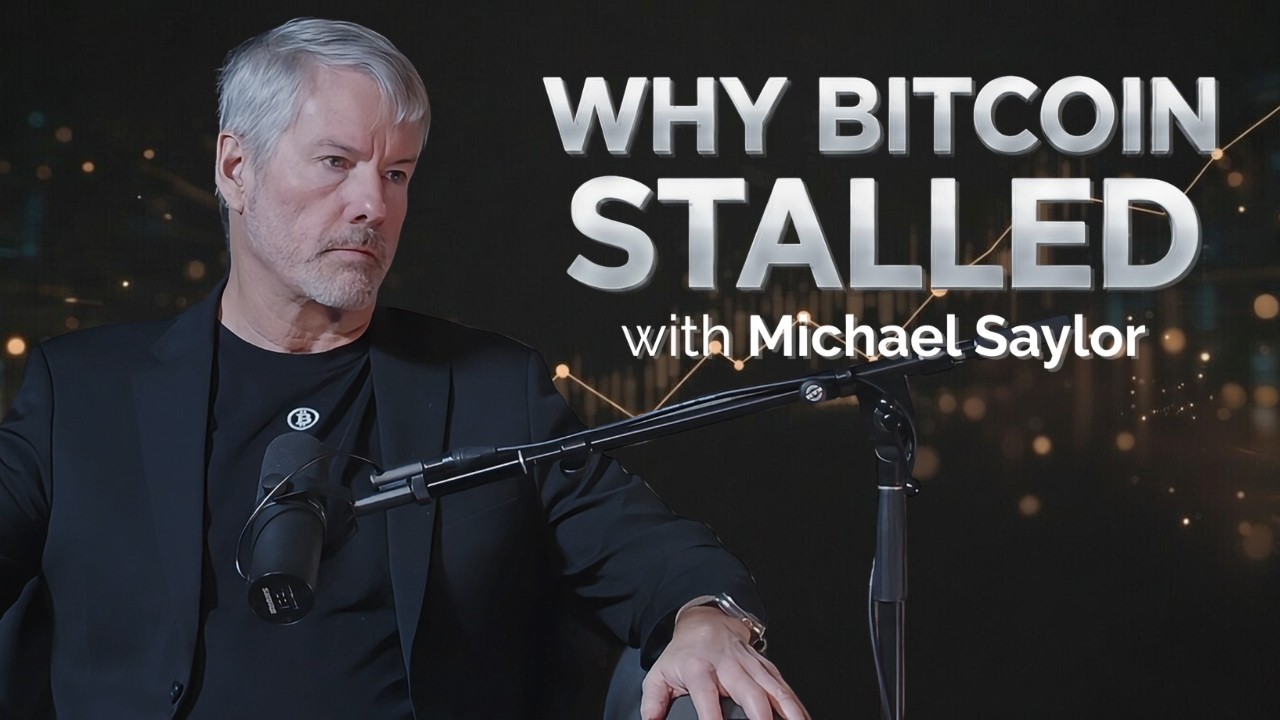 Michael Saylor: Why Bitcoin Stopped at $126KHis explanation of the cycle top, given early in the drawdown.26 Feb 2026
Co-founder and Executive Chairman of Strategy (formerly MicroStrategy), the largest corporate holder of Bitcoin — around 846,000 BTC as of 20 September 2026. An MIT graduate who built a business-intelligence company in 1989, he turned its treasury into Bitcoin in 2020 and has been the asset's loudest institutional advocate since.
Not reliably fixed — most of it is tied to Strategy stock and personal Bitcoin, both of which move violently with the BTC price. Estimates published during a drawdown are stale within weeks. Treat any single figure with suspicion.
He says he has never sold any of his own — “not one satoshi.” Strategy, the company, has: 32 coins in May 2026, then 3,588 coins for about $216m on 6 July 2026 at roughly $60,000 — below its own average cost — and roughly $105m more in early August, to fund preferred dividends and buybacks. That reverses the “we'll never sell” line he gave CNBC in February 2026.
He is an advocate with a roughly $70bn position, not an analyst, and his direction never changes — so he tells you nothing about timing. On this page's 2026 sample his two reasoned bullish calls both ran into a 24% drawdown, one of them naming a floor that broke, while a four-word August post landed near the low. Read him for the long thesis; never trade the timing.
Maximum permanent exposure: raise capital through convertible debt, equity and preferred stock, convert it to Bitcoin, and hold. No stops, no levels, no exits — the bet is that a fixed-supply asset compounding roughly 30% a year makes entry timing irrelevant. The leverage is what makes it work and what makes it dangerous.
Saylor's whole edge is conviction and size — one asset, no exits, and a balance sheet behind it. How close is your instinct? Measure it for real with a Trader Passport.
Now put your own read to work. Test your edge on live market data — no capital at risk — in a free BuyCrypt tournament with real prizes.
Informational and educational analysis based strictly on publicly available materials — dated third-party coverage and his own public posts, linked on every call. Not financial or investment advice, and not affiliated with or endorsed by Michael Saylor or Strategy. Figures are approximate and change constantly. Spotted an error, or are you Michael? Submit a correction →
Verified handles · Sources cited above · Scoring methodology · Updated 26 September 2026