
@julianhosp
An Austrian medical doctor and ex-pro kitesurfer who became one of crypto's loudest German-language bulls — then sold everything in January 2025, shorted Bitcoin and rotated into the Nasdaq. He now publishes a dated written market note every weekday, which makes his bear case unusually easy to check. Some of it worked. Some of it failed badly.
In short. Julian Hosp spent a decade as a crypto founder and evangelist — co-founder of TenX (the $80M PAY token sale of 2017) and later of Cake DeFi / Bake — before flipping to become one of the most vocal Bitcoin skeptics in the German-speaking world. Since January 2025 he says he holds no Bitcoin at all. His thesis is narrow and repeated almost daily: Bitcoin has no remaining use case, its price is held up almost entirely by Michael Saylor's Strategy, and when that buyer runs out of cash the whole structure unwinds. He publishes it in writing, dated, on his own blog — so it can be scored. Over our window that record is mixed and then badly wrong: his May 2026 “stay out” note landed six days before the local top, but he saw “no bottom” at $64K in June and floated a sub-$1,000 entry five days before Bitcoin's actual low, after which it rallied 36%.
Hosp trained as a medical doctor in Innsbruck and competed as a professional kitesurfer before entering crypto in 2015. In 2016 he co-founded TenX, a Singapore crypto-card startup whose PAY token sale raised roughly $80 million in 2017. The product never shipped at scale and the token collapsed; Hosp left the company in 2019 after falling out with his co-founder, and has since said he can only speak for the period up to the end of 2018. He then co-founded Cake DeFi (later Bake), a yield and staking platform, and announced the sale of Bake's assets in December 2024. Both ventures are part of the record and both drew heavy public criticism — this is not a clean résumé, and readers should weigh it accordingly.
In January 2025 he sold his crypto, publicly shorted Bitcoin for a period, and moved into the Nasdaq-100 (QQQ). He now runs his own family office — he states over $100M under management, a self-reported figure we cannot verify — and publishes the Daily Snippet, a short written market note every weekday, alongside a German-language YouTube channel with 181K subscribers. That daily written cadence is why he is worth tracking: unlike most video-first educators, his calls are timestamped text on his own domain, which makes both the hits and the misses permanent.
Sources: julianhosp.com/blog (Daily Snippet) · x.com/julianhosp · youtube.com/@julianhosp
One thesis, repeated daily. Hosp is not a chartist — he barely uses levels, and when he does (the July 2026 death cross) it is as a footnote. His method is a single structural argument: Bitcoin has lost every narrative it once had (digital gold, inflation hedge, payments, speculation), so the only thing holding the price up is Michael Saylor's Strategy buying with borrowed money. From there he tracks Saylor's balance sheet — preferred-share prices (STRC, STRF, STRK, STRD), fundraising capacity, dividend obligations, cash runway — as his real price indicator, plus risk-adjusted performance versus the Nasdaq and retail interest proxies (search, app data, conference attendance). It is a genuinely coherent framework and it is the reason he called the May top well. Its weakness is that it has no mechanism for being wrong: because he treats a bottom as impossible until Saylor is liquidated, he cannot recognise one when it forms — which is exactly what happened in July 2026.
Near the bearish extreme on Bitcoin and has been since January 2025. He is not a permanent skeptic by temperament — he rode three Bitcoin cycles and says he wants a fourth — but his stated re-entry condition (Saylor liquidated, quantum risk resolved, Bitcoin under $1,000) is so extreme that in practice the posture is one-way.
Eight dated calls taken from his own dated posts on julianhosp.com — the written Daily Snippet through July 2026, then the weekly finance write-up that replaced it — each quote verified verbatim on the live page and charted against real Bitcoin price. He is a thesis caller, not a level caller, so most entries are directional (“no bottom”, “clearly lower prices are coming”) and we judged them on what price actually did next. The shape of the record is worth stating plainly: he was right in March and best in May, calling stay-out six days before the window high — and then wrong at the worst possible moment, seeing no bottom in June and floating a sub-$1,000 entry five days before Bitcoin's actual cycle low of $58,566 on 1 July 2026.
“Daher rechne ich mit einem weiteren Rückgang auf 20.000 bis 30.000 Dollar.”
“So I expect a further decline to $20,000–$30,000.” Said with BTC at $64,738, in a post headlined “3 simple reasons why we could soon see $20,000 to $30,000.” It never got close: the deepest print afterwards was $58,566 on 1 Jul (−9.5%), and Bitcoin now trades at $81,413, +25.8% above where he wrote it. The direction paid for a few months; the level was off by more than half.
SourceBitcoin stürzt unter 63.000 $ — Daily Snippet, julianhosp.com↗ julianhosp.com“Grundsätzlich bleibt das Bearish-Sentiment für mich aufrecht, denn es gibt aktuell überhaupt kein neues Narrativ.”
“Fundamentally my bearish sentiment stands, because right now there is simply no new narrative.” Written at $72,752 into a rally he called a routine bear-market bounce. It cut both ways: Bitcoin first ran +12.7% higher to $82,018 on 11 May — two months of being underwater — before falling −19.5% to $58,566. Today it sits at $81,413, +11.9% above his note, so we log this open: the drawdown he predicted arrived, the level did not, and price is back above him.
SourceKrypto-Euphorie: warum der Bitcoin-Pump trügt — Daily Snippet↗ julianhosp.com“Für mich ist es nur eine Frage der Zeit, bis wir noch deutlich tiefere Preise sehen werden.”
“For me it is only a matter of time until we see clearly lower prices.” Said at $68,727, arguing that with Strategy as the only structural buyer the whole market was propped up. It played out: Bitcoin fell −14.8% to $58,566 by 1 Jul. Worth being precise about what he got right — the drawdown, not the destination; price has since recovered to $81,413, +18.5% above the day he wrote it.
Source98 % der Bitcoin-Käufe kommen von einer einzigen Firma — Daily Snippet↗ julianhosp.com“Schau dein Investment nicht nur in Dollar an, sondern auf risikoadjustierter Basis. Und da ist Bitcoin zurzeit einfach eine Katastrophe.”
“Don't look at your investment only in dollars, but on a risk-adjusted basis. And there Bitcoin is currently simply a catastrophe.” His best-timed note of the window: written at $79,826, six days before Bitcoin's window high of $82,018 on 11 May. Upside from there was just +2.7%; the fall that followed was −26.6% to $58,566. Staying out was the right call, and the risk-adjusted framing — not a price target — is what got him there.
SourceWarum Bitcoin keine spannende Risk Adjusted Rendite liefert — Daily Snippet↗ julianhosp.com“Für mich ist Bitcoin aktuell kein Einstieg. Ich sehe keinen Boden. Ich sehe keinen Turnaround. Ich sehe eher, dass sich der Abverkauf beschleunigen kann.”
“For me Bitcoin is currently not an entry. I see no bottom. I see no turnaround. I rather see the sell-off accelerating.” Said at $64,047. There was −8.6% left in the move — the low came four weeks later at $58,566 on 1 Jul — and then it turned hard the other way. Bitcoin is now $81,413, +27.1% above his note. The sell-off did not accelerate; it ended.
SourceBitcoin sieht keinen Boden: warum das Saylor-System zerreißt — Daily Snippet↗ julianhosp.com“Ich könnte mir gut vorstellen, dass ein Einstieg dann unter 1.000 Dollar bei Bitcoin liegt und vielleicht das nächste Top bei 10.000 Dollar.”
“I could well imagine that an entry would then be below $1,000 for Bitcoin, and maybe the next top at $10,000.” The single worst-timed call on this page. Written at $59,727, five days before Bitcoin bottomed at $58,566 on 1 Jul — a further −1.9%, and that was the whole remaining downside. From there it rallied to $81,413, +36.3%. His stated re-entry price is roughly 98% below where Bitcoin trades today.
SourceStrategy unter Druck: die Rosen Untersuchung — Daily Snippet↗ julianhosp.com“Traditionell ist das natürlich eher ein sehr bearishes Signal, und das könnte nach vorne gehend schon ziemlich Druck wieder auf den Markt ausüben.”
“Traditionally that is of course rather a very bearish signal, and going forward it could put quite a lot of pressure back on the market.” On the 50-day crossing below the 200-day at $63,701. The pressure never came: the worst print afterwards was $62,773 on 2 Aug (−1.5%) and Bitcoin then ran to $81,413, +27.8%. To his credit he hedged it himself in the same post, calling a death cross “a warning signal, not a verdict.”
SourceTodeskreuz bei Bitcoin: Kippt jetzt der starke Juli? — Daily Snippet↗ julianhosp.com“Ich habe zurzeit keine Pferde in diesem Rennen, denn ich investiere aktuell gar nicht in Krypto. Ich war immer wieder short, aber ich bin nicht long.”
“I currently have no horses in this race, because right now I am not investing in crypto at all. I was short again and again, but I am not long.” Written at $64,263 in the weekly finance post that replaced his Daily Snippet, where he also said Bitcoin needed “a new use case and a new narrative” before it could turn, and asked what would happen to it if stocks fell 20–30%. The market answered the other way: the worst print afterwards was $62,844 on 17 Aug (−2.2%), and Bitcoin ran to $81,413, +26.7%. Staying out cost him the whole move.
SourceNeue All-Time-Highs, Aschenbrenners Absturz und wie ich ein Portfolio strukturiere — julianhosp.com↗ julianhosp.comOutcomes are our read of his stated bias against real price, not his own scoring. Every quote is German verbatim from his own dated blog posts (linked on each card), not paraphrased; the English rendering that opens each summary is ours. His long-horizon claims (sub-$1,000 Bitcoin, Strategy insolvency) are unresolved and could still turn — near-term marks can flip as the cycle resolves.
Hosp's income no longer comes from crypto. It comes from an education and community business — courses, a paid inner circle, a daily paid update — plus his own family office. That matters here in a specific way: his free content is the funnel, and a permanently alarming Bitcoin thesis is good funnel material. Weigh it accordingly.
The free Daily Snippet and YouTube videos consistently end in a call-to-action for his paid Inner Circle, a paid Daily voice-note service, or a free PDF that collects leads. The bear case and the sales pitch share a page.
He describes himself as CIO of his own family office with over $100M under management — self-reported and not independently verifiable. He states he holds no Bitcoin and is long the Nasdaq-100 (QQQ), so his public bias matches his stated book.
He co-founded TenX, whose PAY token raised ~$80M in 2017 and subsequently collapsed, and later Cake DeFi / Bake, whose assets he announced as sold in December 2024. Both are relevant history when weighing his current claims about other people's token structures.
“Ich könnte mir gut vorstellen, dass ein Einstieg dann unter 1.000 Dollar bei Bitcoin liegt und vielleicht das nächste Top bei 10.000 Dollar.”
26 Jun 2026 · five days before the cycle low — his re-entry price, 98% below today“Schau dein Investment nicht nur in Dollar an, sondern auf risikoadjustierter Basis. Und da ist Bitcoin zurzeit einfach eine Katastrophe.”
05 May 2026 · his best-timed note — six days before the top“Für mich ist Bitcoin aktuell kein Einstieg. Ich sehe keinen Boden. Ich sehe keinen Turnaround.”
04 Jun 2026 · the thesis that cannot see a bottomQuotes transcribed from his own public sources; stated views, not recommendations.
Hosp publishes daily in German — a written Daily Snippet on his blog and near-daily video. Representative recent Bitcoin videos:
 50% Verlust! Meine eiskalte Bitcoin-Prognose für die nächsten 18 Monate.His 18-month bear forecast, published two weeks before the cycle low.18 Jun 2026
 Saylor opfert #bitcoin ! Die Bitcoin-Todesspirale.The “death spiral” framing — Strategy's balance sheet as the only thing holding the price.29 Jun 2026
 Das heimliche Ende von Bitcoin! Warum niemand die Wahrheit sagt.The narrative-decay argument, from the day before his best-timed written note.04 May 2026
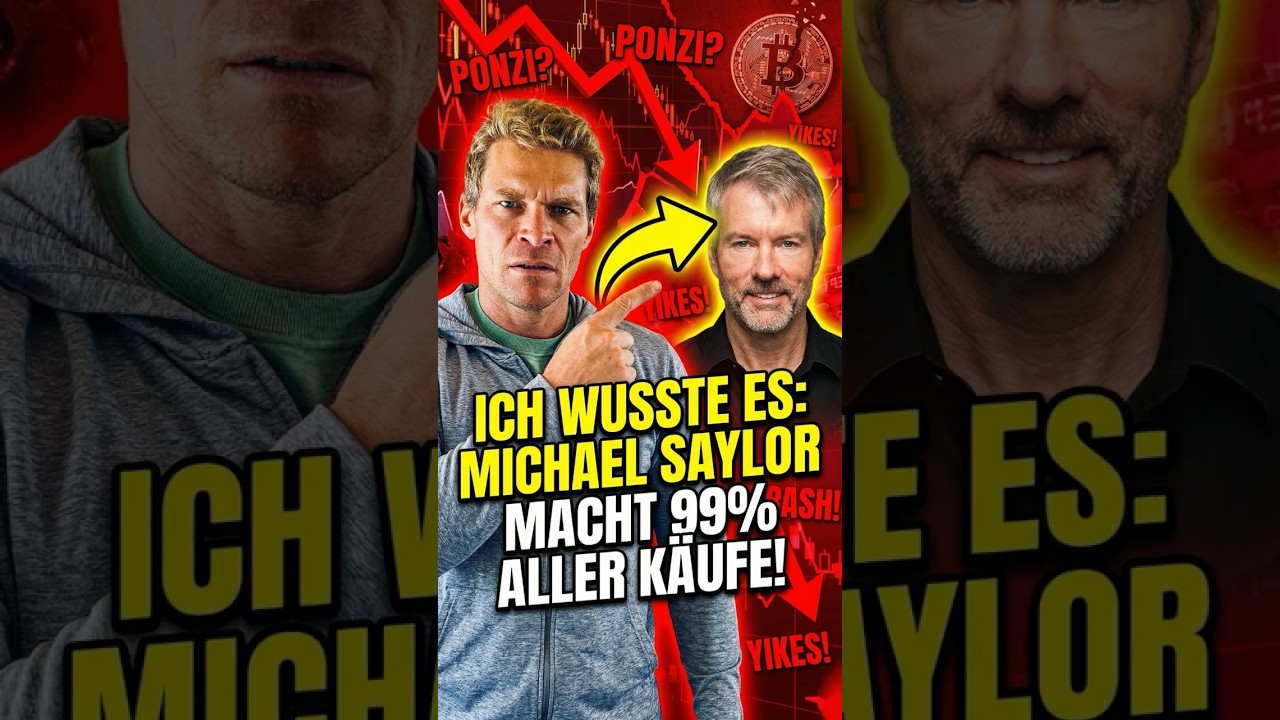 SCHWARZ AUF WEISS: Michael Saylor kauft 99% aller Bitcoins!The single-buyer thesis in its clearest form.26 Mar 2026
An Austrian medical doctor and former professional kitesurfer who became a crypto founder — co-founder of TenX (the 2017 PAY token sale) and later Cake DeFi / Bake. He sold his crypto in January 2025 and is now one of the most vocal Bitcoin skeptics in the German-speaking world, publishing a daily written market note and a YouTube channel with 181K subscribers.
He is bearish. In February 2026 he wrote that he expected a further fall to $20,000–$30,000, and in June 2026 he said he could imagine re-entering below $1,000 with the next top around $10,000. Neither has happened — Bitcoin bottomed at $58,566 on 1 July 2026 and trades near $81,413 today.
He is a commentator with a paid education business, not a licensed adviser, and his history includes two ventures that drew heavy criticism (TenX and Cake DeFi / Bake). His published record over our window is mixed: his May 2026 stay-out note landed six days before the local top, but his June 2026 “no bottom” call came days before the actual low. Treat his views as a documented, dated opinion — never trade them blindly.
He says he exited in January 2025 and rotated into the Nasdaq-100 (QQQ) because Bitcoin had lost every narrative it once had — digital gold, inflation hedge, payments — and because he believes the price is sustained almost entirely by Michael Saylor's Strategy buying with borrowed money. He argues Bitcoin's risk-adjusted return against the Nasdaq is the number that matters.
Hosp sold the top of his own conviction and never bought back. Strong opinions, held daily, checked rarely. How close is your instinct — measure it for real with a Trader Passport.
Strong opinions are cheap; a scored record isn't. Test your own edge on live market data — no capital at risk — in a free BuyCrypt tournament with real prizes.
Informational and educational analysis based strictly on publicly available materials — his own dated Daily Snippet posts on julianhosp.com and public X posts, linked on each call. Quotes are German verbatim; English renderings are ours. Not financial or investment advice. Figures are approximate and change constantly. Spotted an error, or are you Julian? Submit a correction →
Verified handles · Sources cited above · Scoring methodology · Updated 21 September 2026