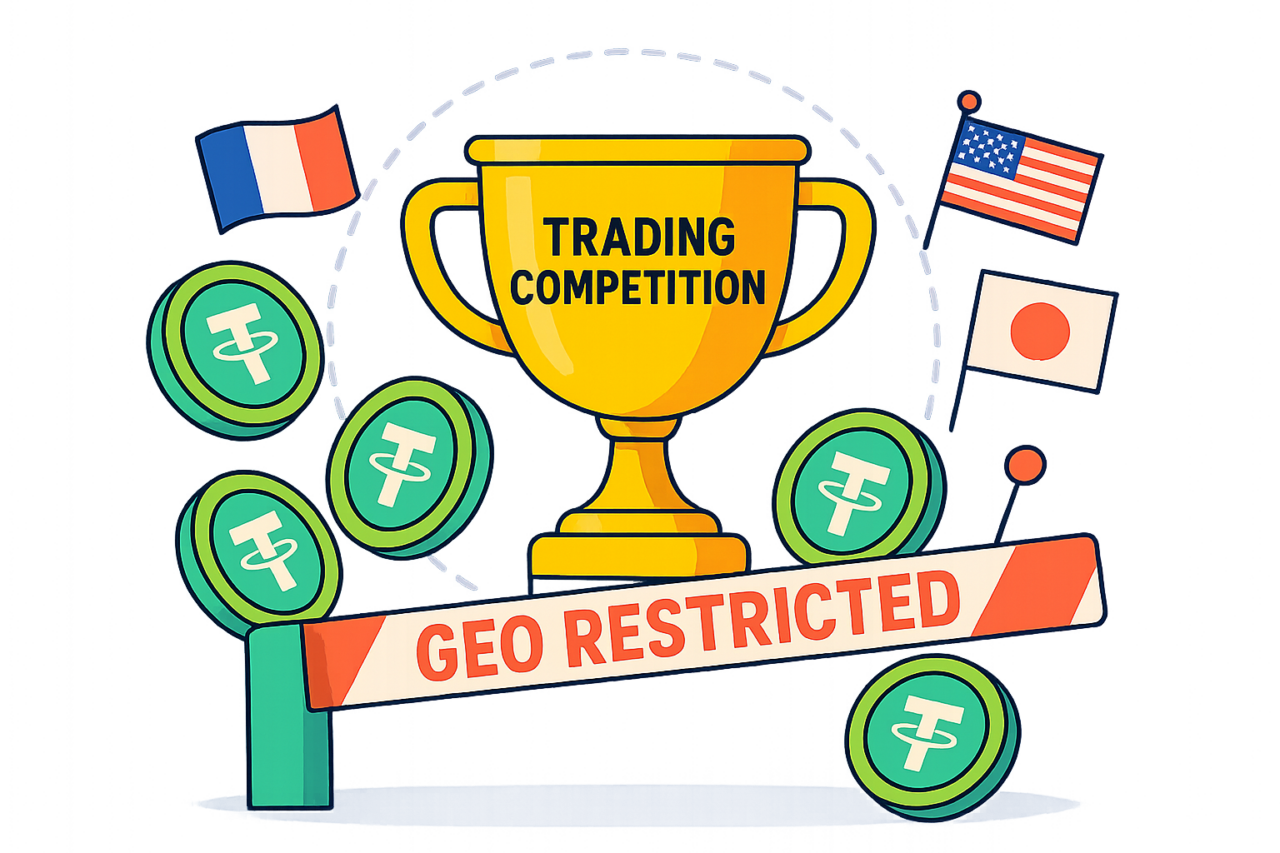
Whether a platform is available to you, or if you can put in an entry for a tournament, get your KYC done and be in with a chance at the prizes, all comes down to crypto trading competition geo restrictions. The rules are not uniform; they are dictated by your country of residence, the exchange, the event in question and local compliance. It is not uncommon for a trader in the US to have a different set of options than one in India, Vietnam, the UAE or Turkey.
The reasons for this
On the surface a crypto tournament may appear to be a global affair but in reality many are regional. A centralized exchange has to abide by internal risk controls as well as local licensing, sanctions and consumer-protection standards. Such obligations will bar some countries from participating or place limits on what can be won.
Then there is the matter of format. Regulators will take more notice of a live contest that involves customer funds than a simulated one run on real market data. And when it comes to handing out prizes in USDT, there are further compliance issues to resolve.
What to look into prior to entering:
- Any residency or citizenship stipulations
- KYC and the need for real-name verification
- The official rules for restricted jurisdictions
- How and whether you are eligible for a payout
- Tax reporting
- Age and account minimums
Do not be under the impression a VPN makes your legal residency anything other than what it is. Misrepresentation of the facts is grounds for having your account closed, being disqualified or not seeing your prize money.
Trading in the US and UK
Platforms have to contend with derivatives, promotional and licensing restrictions, so you will find US and UK traders left out of a good number of CEX tournaments. An exchange site may be open to you but the event is not.
“Trading competition US restricted” is shorthand for any of the following:
- The exchange does not do business with residents of the country.
- The jurisdiction is off limits for the tournament.
- The trader can make use of the platform but is not entitled to any of the promotional rewards.
It is worth reading the event page in full. Pay heed to terms like “excluded territories” or “residency requirements”, not to some banner touting the event as global.
Or try a simulated contest. BuyCrypt puts on free demo trading and crypto tournaments with real market data where one can go up against others for USDT without a deposit. BuyCrypt is no exchange and does not trade in cryptocurrency.
A Country by Country Guide
In some places there is a robust local exchange and contests to match, in others you are looking at international platforms or in-person affairs. What is on offer in a given country is as much about the local market structure as it is the trader.
| Country or region | Common access pattern | Rules to check |
|---|---|---|
| United States | CEX promotions are in short supply though you may find a demo format | State rules, KYC and the like |
| United Kingdom | Access to a product or promotion varies | Financial and regional eligibility |
| Vietnam | Strong interest in online and local contests | Identity and payout rules |
| Turkey | A culture of active local exchange competition | Platform terms and tax treatment |
| Russia and CIS | Well-established communities for trader contests | Sanctions, payment access and country lists |
| South Korea | Local participation with strict identity rules | Real-name accounts and local compliance |
| India | Access to local and international venues is mixed | VDA tax, 1 per cent TDS and prize taxation |
| UAE and MENA | Dubai in particular sees its share of regional events | VARA rules, residency and event eligibility |
| LATAM | A mix of offline and online events | Verification and tax rules |
Take this as a guide only. The policy is liable to change and the event’s own rules are what determine eligibility.
Demand in Vietnam
With a sizeable community of crypto traders, Vietnam is keen on educational competitions of the regular variety. Local affairs might see a combination of workshops, community challenges and an online leaderboard. One such regional format is the TradingView VN Leap.
Users would do well to verify if an event is open to residents and what the method of payment for prizes is. A global CEX tournament will have its own way of doing things compared to a local one.
Demo trading is a way to put strategies to the test without putting a deposit at the mercy of the market, but then again a simulation is just that; the realities of liquidity and emotion in a live environment are something else.
Local Events in Turkey
BtcTurk and Paribu are among the active local platforms in a market as big as Turkey. Contests here can be in the form of performance leaderboards, educational drives or challenges based on volume.
Look at the fine print on eligibility. Some will want a verified account on the platform, others will put certain locations in the exclude column. Prize calculations may depend on trading volume, net performance or a fixed scoring formula.
As for the prize, it is not to be equated with trading profit; Turkish rules and the platform will make a distinction between the two.
Participation from Russia and the CIS
There is a tradition of trader competitions in Russia and the CIS, with communities focused on crypto and events from the likes of Dukascopy and Moscow Exchange (MOEX). There can be a stark contrast in access from one country to the next.
Participation is subject to residency checks, platform policies, sanctions and the like, not to mention payment rails. A trader in a CIS nation might be in order, yet someone in an adjacent country will find himself excluded; do not take “CIS access” for granted.
Prizes are not all handed out the same way. Some are put on-chain or credited to an account, others by means that may not be open to you where you are. It is best to make sure of how they are delivered before you sign up.
South Korea: Real Name Policy
Crypto activity in South Korea is governed by stringent financial and identity compliance. With Upbit and Bithumb among the platforms operating on a real-name basis, tournament eligibility could hinge on your exchange, bank and identity details being in alignment.
That is not the case in some other parts of the world where local banking is no barrier to registration. In Korea, expect to need an eligible account and local verification, possibly proof of residency, to get into a contest.
WSOT has seen its share of Korean traders at major international affairs but with the usual exclusions. Rely on the rules as they stand today rather than what was available in the past.
Indonesia, India and MENA
Indonesian traders will come across such local venues as Indodax, Tokocrypto and Pintu, all of which have their own promotional and compliance stipulations. One should ascertain if a contest is open to residents and in what form rewards are given, be it crypto or the local currency.
India is a matter of tax prudence. The 1 per cent TDS and VDA regulations bear on crypto dealings and the disposition of any tournament winnings is a function of the facts and prevailing guidance; a professional opinion on taxes would not be amiss.
Dubai and the rest of the MENA area are home to no shortage of crypto events. But VARA can put requirements on those doing business with Dubai residents. See if the operator is properly authorised and check on residency eligibility.
Regional Variety in LATAM
You will find active communities in Argentina, Mexico and Brazil putting on everything from online tournaments to offline trading and local meetups. While there may be more to go after than in the US, local rules are in force.
Licensing or restrictions on prizes and payments can mean an event is open to one LATAM country and not another. Put in the time to look over the verification process, tax documents and what the payout currency is before you put yourself on a leaderboard.
CEX Tournament Alternatives
When an exchange is off limits there are still ways to gain some competitive experience without parting with funds. Whether for a public leaderboard, a formal evaluation or to run a simulation, the format is up to you.
| Format | Deposit required | Benefit | Limitation |
|---|---|---|---|
| Demo tournament | Usually no | Practice with simulated funds | Results may differ from live execution |
| Exchange CEX contest | Varies | Real platform environment | Country exclusions and KYC |
| Trading simulator | Usually no | Test rules and risk limits | May have no real prizes |
| Crypto prop firm alternative | Often an evaluation fee | Structured targets and rules | Fees and drawdown limits |
| Offline event | Varies | Community and education | Limited locations |
BuyCrypt caters to those wanting demo contests and free crypto trading tournaments. As a competition site and not an exchange one cannot transact there, but with the use of live market data a qualified user can put in for USDT prizes of the real kind. There is no deposit needed.
Make sure you know the answers to the following before you join:
- How the rankings are done
- Whether leverage is in fact simulated
- The drawdown or loss cap
- How ties are broken
- When winners are verified
- The method and timing of prize payments
Check Rules Before You Enter
Geo restrictions on a crypto tournament can have an impact on your eligibility, the prizes and even tax reporting. Determine your true residence and familiarise yourself with the official rules and KYC obligations before trading.
For those in the US, a demo or skill-based affair is often more attainable practice than what CEX promotions put forward. Pick something that is transparent about who can enter, how performance is measured and how rewards are made good.
FAQs
I want to compete in a crypto trading tournament, where can I?
It is a question of your residency, KYC and the event’s rules. You might find options with regional or international platforms, demo contests or your local exchange.
What is it with US traders being barred from certain tournaments?
Compliance at the state level, derivatives, sanctions or licensing can lead a platform to put a restriction on a US resident for an event, even if they are served in other respects.
Is KYC a must for these tournaments?
For the most part yes, particularly with centralised exchanges where real-name verification is called for. Even a demo contest might ask for less but will likely want to check your identity when it comes to paying out.
Joining a restricted contest with a VPN?
Your legal residency is unchanged by a VPN. To misstate your location is to risk having your account closed or prizes held back, not to mention a breach of the rules.
Is BuyCrypt an exchange?
BuyCrypt is not that. The platform puts on free crypto trading tournaments and demo contests of the sort one would expect. With simulated trading drawn from actual market data, it enables qualified users to put in for a shot at USDT prizes in real terms and with no deposit required; there is no cryptocurrency sold here.
Related on BuyCrypt: play a free tournament · how funding works · Instant Funding Crypto
Every major exchange tournament: what is live now, announced vs distributed prize pools, history since 2020. Updated nightly.

Автор Benjamin Redfern
I was born in 1979 in Dunedin, New Zealand, where cold mornings, steep streets, and strong opinions about rugby were part of ordinary life. I use Benjamin Redfern as my public name. My private identity remains known only to close family and long-standing friends.
Discussion
Comments from BuyCrypt Live. Sign in with Google or Apple — we create your BuyCrypt account on the way, the same one as in the app.








Comment removed