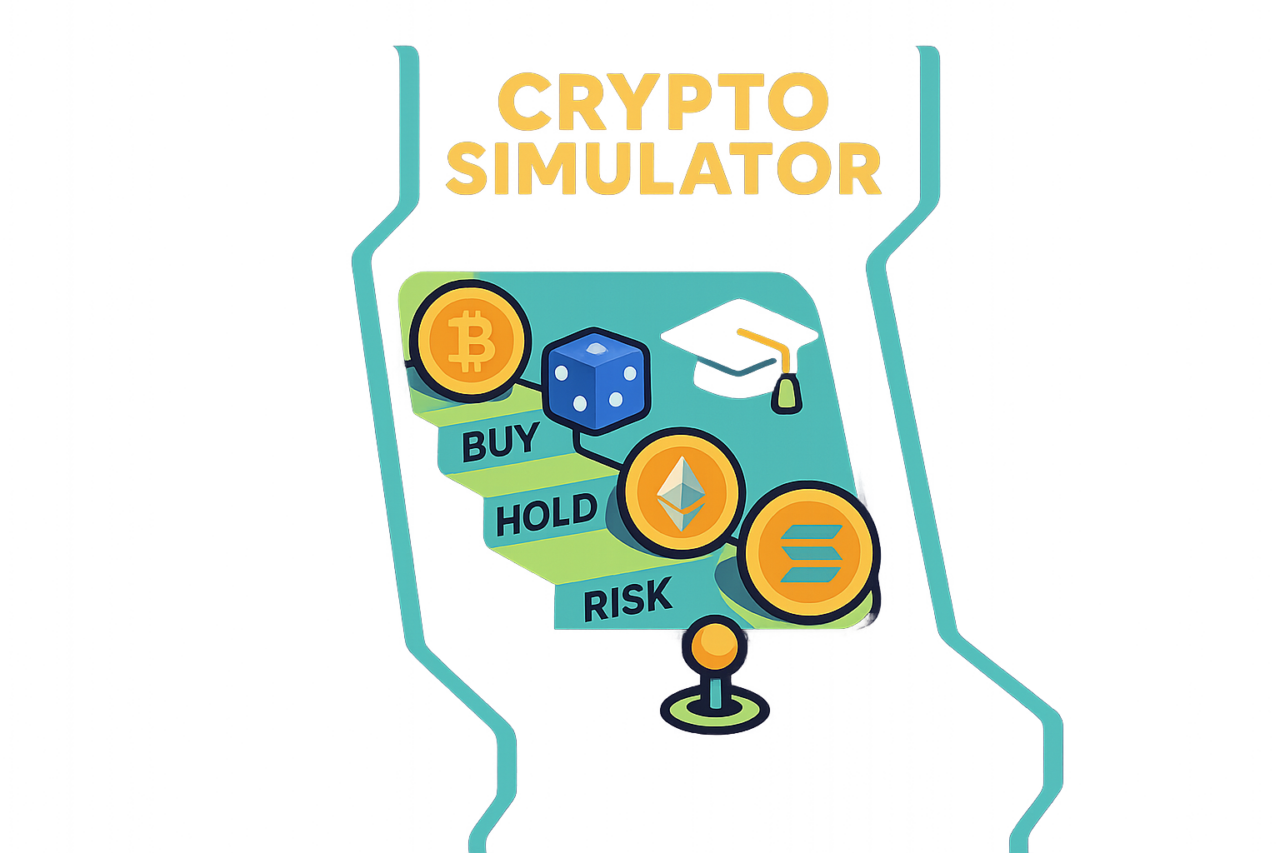
With a crypto simulator, students can put their trading skills to the test using virtual funds and actual market data, all without making a deposit. BuyCrypt offers demo contests and free tournaments that provide a means of competing and studying charts or trying out a strategy without any personal money on the line.
What constitutes a crypto trading simulator?
In essence it is an application that mimics the act of placing a trade sans real cryptocurrency. One is given a demo balance from which to pick an asset and set a position size, then see how the simulated trade fares.
Such paper trading or demo trading is useful for a novice to get to grips with risk management, technical analysis and the likes of stop-loss, limit and market orders prior to committing any real funds. Perpetual futures contracts enable continuous trading without expiration, enhancing practical learning opportunities for students in simulated environments.
- Virtual funds in place of your own
- Market prices that are live or as good as
- A record of performance and trades
- Position sizing practice
- Leaderboards for some competition
- An environment to put strategies to the review
The simulator may do away with the need to deposit while you are at it, but not the uncertainty of the market. There is volatility, fees, liquidity constraints and emotional strain in real trading, to say nothing of the chance of a loss.
Paper Trading for Students
It is an economical way for a student to make a few errors, re-examine one’s choices and go over the exercises again. Crypto paper trading is well suited to both independent work and the classroom.
An instructor might have a student put forward the reasoning for a position and its size, or when it would be voided; this instils proper decision-making rather than leaving it to guesswork.
- See how limit and market orders are done.
- Study the price chart for trends.
- Determine position size ahead of time.
- Make note of the exit plan and why you entered.
- Look at the outcome, original rules intact.
Then again, a demo is no guarantee of how you will do later. It can be deceptively simple when there is no money of yours involved, so take it in stride but be aware of the limitations.
The BuyCrypt Free Simulator
BuyCrypt puts on free crypto trading tournaments and demo contests, though it is not an exchange and does not deal in digital assets.
Eligible participants face off in simulated trading with real data, no deposit needed. You will be allocated a virtual balance and your results posted to a leaderboard in keeping with the contest format.
- Make yourself familiar with the scoring, assets and dates of the contest.
- Put your demo balance to work with some planned trades.
- Observe your drawdown and trade behaviour.
- When it is over, check the prize terms and where you rank.
Occasionally a contest on BuyCrypt has USDT prizes up for grabs. But entry and verification requirements are subject to change so have a look at the details first. Do not think of a free contest as a source of income; it is a matter of skill.
Major Market Prices
For a demo platform to be of any use it has to mirror the market. BuyCrypt allows for just that, so there is no need to put down funds on an exchange to observe price action.
The data will be drawn from such as Binance, Bybit or OKX, depending on the product. Expect some minor discrepancies between venues due to the way the data is fed or spreads and timing.
| Item | Illustrative case |
|---|---|
| Entry reason | Price moves above its recent range. |
| Position size | 5 per cent of the demo. |
| Stop-loss | Set below the invalidation point. |
| Target | Pre-determined exit. |
| And after the fact | Did you adhere to the plan? |
If the chart is unkind don’t be in the habit of altering your rules mid-trade, it will only serve to flatter a poor strategy.
A Plan of Study
There is little to be learned by clicking at random. Stick to a routine you can repeat, 20 minutes is enough.
Weeks 1-2
Get used to the interface of the simulator. Open and close some positions, try different order types and have a look at the history. Leave the leaderboard alone for now.
Weeks 3-4
Introduce some risk management. Be consistent with your position size. Put the reason for your entry on paper and know what price would put paid to your thesis. Once a trade is in the past, make a point of reviewing it.
Month Two And Beyond
Pick a setup to get to grips with, be it a support-and-resistance reaction, a trend pullback or a breakout. Narrow your rules; you will find a modest plan that can be repeated is more amenable to testing than five disparate notions.
A sensible way to go about things is:
Demo account → trade journal → free tournament → performance review → and from there a funded evaluation if warranted.
There is no hurry to put real money on the line. One develops skill by going over one’s work again and again, not by increasing the size of positions.
Free Crypto Tournaments at BuyCrypt
The free tournaments from BuyCrypt are an opportunity for students to have some structured practice over a set time. They allow you to put your decisions to the test without any personal deposit at risk, feel the pressure of a leaderboard and see how your simulated results stack up against others.
But do read the fine print before entering a crypto trading competition:
- Contest times
- Eligible assets and the rules
- Leverage and demo balance
- How the ranking is done, including tie-breakers
- Prize and payout terms
- Any verification or activity minimums
A leaderboard is only as good as the contest it is in, it does not tell the whole story of your ability as a trader. A good showing could be down to market conditions of the moment; what matters is whether the decisions were sound and repeatable.
The Funded Account Route
Under the right circumstances, some of our programs might open the door to a crypto funded account for a student, say a $5,000 one with a profit split. The specifics of the offer and its structure are governed by the program in place at the time.
Expect to see position limits, restricted behaviour, maximum daily loss and total drawdown in any funded trading programme, along with the conditions for a payout. An 80% profit split is not a promise of returns, you have to abide by the rules first.
| Term to check | Why it matters |
|---|---|
| Daily loss limit | This puts a cap on what can be lost in a day |
| Total drawdown | The most the account can fall |
| Profit split | How gains are apportioned |
| Payout rules | The requirements and timing |
| Account model | Live or simulated |
Don’t count on a funded offer as an easy source of income. It is an exercise in discipline, so read all the conditions.
Put in the learning before you use real money
Volatility, fees, leverage and liquidity all have their effect on outcomes, so understand them. Your plan should be something you can put into plain words: why you are in or out, which markets and timeframes you have a handle on, where a trade is voided, how you would deal with a string of losses and what you are prepared to put at risk on a single idea.
- What you are prepared to put at risk on a single idea
- Where a trade is voided
- How you would deal with a string of losses
- Which markets and timeframes you have a handle on
- Why you are in or out
BuyCrypt is here to underpin your practice but we do not dispense financial advice or guarantee you will make a profit. Should you come to use real funds, make sure it is money you can part with and in accordance with the law.
Crypto Simulator FAQs
Is there a cost for students?
No deposit is needed to be eligible for the demo contests and free tournaments we put on. You will want to look at the prevailing terms for each as to entry and prizes.
Does the simulator involve real money?
It doesn’t. The trades are virtual. While BuyCrypt may employ actual market data in its contests, the demo balance is not a cash account.
What about KYC?
That will depend on the contest, the location and how the prize is to be paid. See our registration and prize rules for the latest on identity verification.
Are these tournaments a form of gambling?
They are meant to be a test of skill, with participants making calls according to the rules. Do familiarise yourself with the local laws and contest terms.
Can a student get a funded account?
There is a pathway in some programmes, though the terms differ. Make sure you have reviewed the drawdown and profit split parameters and the like before you put any stock in an offer.
More from BuyCrypt: the trading simulator · play a free tournament · App

Автор Benjamin Redfern
I was born in 1979 in Dunedin, New Zealand, where cold mornings, steep streets, and strong opinions about rugby were part of ordinary life. I use Benjamin Redfern as my public name. My private identity remains known only to close family and long-standing friends.
Discussion
Comments from BuyCrypt Live. Sign in with Google or Apple — we create your BuyCrypt account on the way, the same one as in the app.