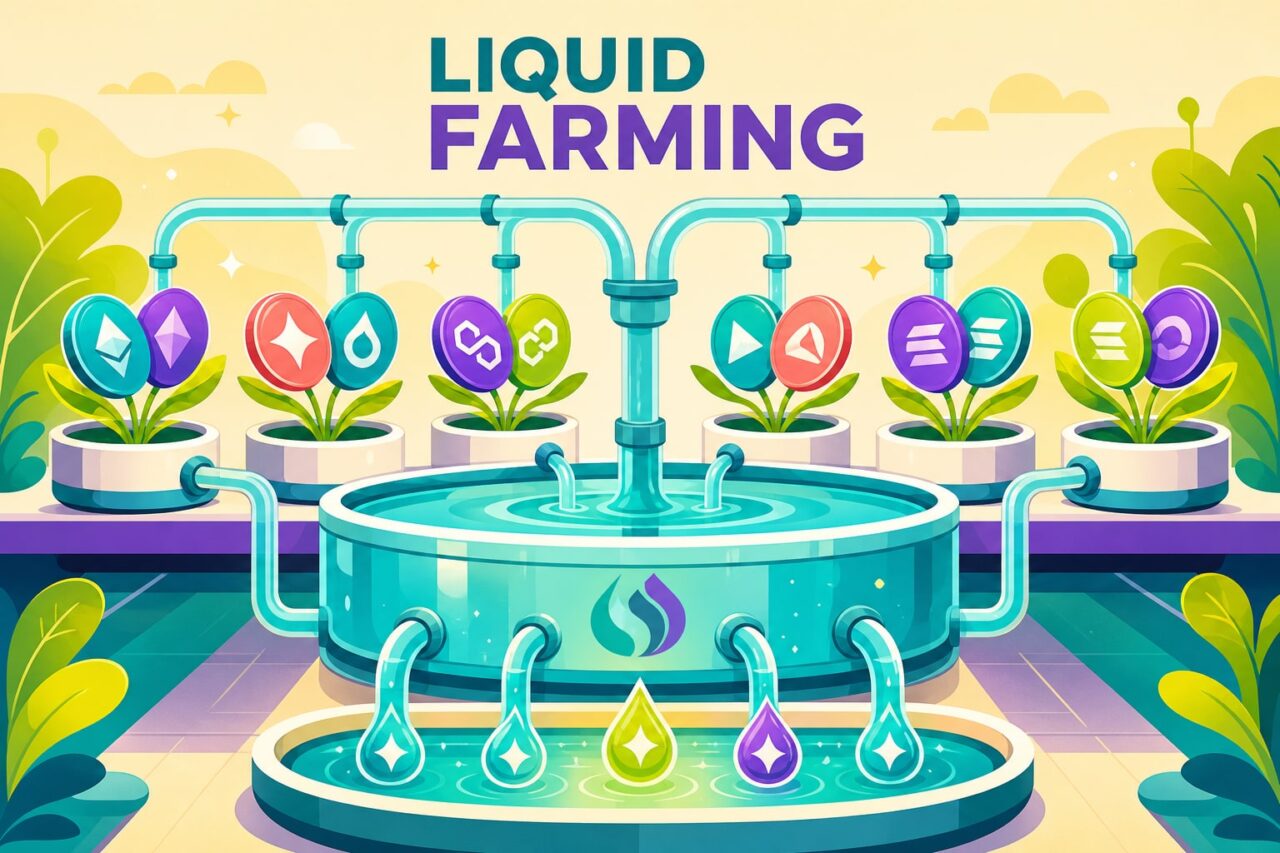
Liquid farming provides an opportunity to earn yield in DeFi through liquidity pools, lending markets, and yield products. LP rewards can be obtained in the form of trading fees, borrower interest, or token emissions. There are also risks when liquid farming, such as impermanent loss, smart contract failures, or depegs that can reduce or eliminate your returns.
What is Liquid Farming?
Liquid farming, or yield farming, is the process of depositing your crypto assets into a DeFi protocol so that others can use it for trading, borrowing, or yield in a structured manner. For this, you may earn trading fees, interest, governance tokens, or other incentives.
Liquid farming can be done via smart contracts on various networks such as Ethereum and Base. These contracts allow you to connect your wallet, choose which pool or market you’d like to deposit your assets into, and get back a claim on your position, usually in the form of an LP token or some other receipt token.
There are various types of liquid farming:
- Pools on automated market maker decentralized exchanges
- Lending markets for stablecoins and crypto
- Liquidity gauges with additional incentives
- Markets for yield tokenization
- Pools with liquid staking tokens
How Do Liquidity Pools Earn?
Uniswap is one of the leading examples of an automated market maker (AMM). It does not use an order book to match buyers and sellers. Instead, it uses liquidity pools containing two assets. When traders pay fees to swap between the assets, some of these fees go to liquidity providers.
For example, you can add ETH and USDC to an ETH/USDC pool. Other traders can swap between the assets, and as a result of these trades, your share of the pool will change. You can earn a portion of the trading fees, but the proportions of assets you have in your pool will likely change from your original deposit.
Curve is a platform that mostly focuses on liquidity pools with similar-value assets, such as different stablecoins or different versions of the same asset. Using pools of similar-value assets can reduce the amount of price divergence that an LP position may be exposed to. However, these pools are still exposed to smart contract risk, liquidity risk, and depeg risk.
| Type | Main Sources of Returns | Key Risks |
|---|---|---|
| Uniswap pool | Trading fees and possible incentives | Price divergence between the two assets |
| Curve pool | Trading fees and reward emissions | Depeg of a stablecoin or wrapped asset |
| Aave lending market | Interest from borrowers | Bad debt, liquidity, smart contracts |
| Pendle market | Trading of yield, or pricing of fixed vs variable yield | Maturity, interest rates, and underlying assets |
APR, APY, and Sources of Rewards
APR is a simple rate of return that’s annualized. APY takes into account the compounding of returns. For example, if a liquidity pool displays an APR of 20%, you can calculate what the APY would be if you reinvested your rewards. The APY would be higher than 20%. However, this calculation assumes that the rate stays the same and ignores any costs that may be incurred. Annualized simple rates like APR are commonly used in finance for straightforward yield comparisons.
In the world of DeFi, these assumptions may not hold. The rate of return for a pool can change based on deposits and withdrawals, trading volumes, asset prices, and reward schedules. The APY that you see for a pool is the APY as of now, and it’s not a promise of what you will earn.
There are generally two sources of yield in liquid farming:
- Trading fees paid by users who swap through the pool.
- Emission rewards distributed in governance or incentive tokens.
Trading fees are real returns based on the activity of the protocol. Emission rewards come from a schedule of token emissions, typically in the form of governance or incentive tokens. These can change or decrease once incentives are no longer distributed. The value of the reward token can also decrease, and that will also reduce the APY. Sometimes, a pool may have a high APY because most of it is coming from emissions rather than trading fees.
Another thing to keep in mind is that compounding can cost you money as well, especially when you have to pay gas and transaction fees.
Boosted Rewards on Convex
Convex is closely tied to Curve and its system for incentivizing liquidity providers. Through Convex, you can participate in liquidity rewards from Curve without having to manage the details of the voting and governance processes. Rewards can be CRV-related incentives, CVX, and other emissions.
“Boosted” rewards refer to an incentive structure rather than to a guaranteed return. The actual rewards earned can depend on the details of gauge votes, liquidity, emissions, and your own position. All of these are subject to governance decisions.
Aerodrome also has liquidity gauges and other ways of incentivizing liquidity providers on Base. Liquidity providers earn a share of trading fees and can also earn emissions. If a high rate of emissions attracts more liquidity providers to a pool, then everyone’s share of the emissions will be reduced. Make sure you understand the rules of a pool and the terms of withdrawal before depositing.
Aave Lending and Pool Farming
Aave is a good comparison to farming pools. Rather than depositing two assets to a pool like an AMM, you deposit one asset into a lending market. Borrowers will have to deposit collateral and pay interest to you, the supplier, who will earn variable yield.
Instead of being exposed to the impermanent loss calculation that applies to AMMs, lending markets are exposed to other risks such as bad debt, liquidations, oracle failures, liquidity issues, and smart contract vulnerabilities. They also have rates that can vary depending on the demand for borrowing and liquidity utilization.
Lending markets like Aave primarily yield in the form of interest from borrowers. On the other hand, farming pools on Uniswap or Curve can have trading fees as well as emissions. Liquidity providers in these pools also have the risk of changing proportions in the assets they’re holding.
Pendle and Yield Tokenization
Pendle allows you to split a yield-bearing asset into a principal token, which is the claim to the underlying asset at the end of a given period, and a yield token, which is the yield that the asset will produce during a set period. This separation allows you to trade and manage your fixed and variable yield separately. For example, one user might be more interested in the claim on the underlying asset at maturity while another might be more interested in the changing yield in the future.
As with all crypto assets and DeFi investments, it’s important to note that tokenizing yield isn’t risk-free. Yield may go down, and maturity will affect the price of the principal and yield tokens. Furthermore, just like any other DeFi protocol, the underlying asset could fail.
Impermanent Loss With an Example
Impermanent loss is the difference between the value of your assets if you had kept them in the AMM pool vs the value of your assets if you had just held them outside of the AMM pool. This loss can be recovered if the asset prices go back to their original relationship. Once the assets are withdrawn from the pool, the loss becomes realized.
For example, if you deposit $1,000 worth of ETH and $1,000 worth of USDC into an AMM, the value of your position in the AMM will be $2,000. If ETH’s price doubles and USDC remains at $1, you would have $3,000 worth of assets if you had just held them outside of the pool.
However, in a constant product AMM pool, arbitrageurs will take advantage of the price difference and rebalance the pool to the new price. Your position in the AMM may be worth about $2,828, minus fees and rewards. Your position has underperformed your hold-only position by around $172, or 5.7%.
Trading fees and emission rewards may make up for this underperformance, or they might not. Impermanent loss is worse when the prices of assets in the pool change significantly. Using stablecoins as a pair can reduce the risk of impermanent loss caused by the two assets diverging in price; however, if one of the assets depegs, it can result in an impermanent loss of a different kind and can be significant.
Smart-contract and Depeg Risks
Smart contract risk refers to the risk that the underlying smart contract may have a bug or an exploit, or be otherwise poorly designed. Audits help, but do not guarantee that a smart contract is safe.
Depeg risks occur when stablecoins are paired with another asset, or when wrapped assets or derivatives that are pegged to another asset are paired with another asset. If one of the assets depegs, the pool will be weighted heavily to the weaker asset.
- Slippage when depositing/withdrawing from a pool
- Thin pool liquidity
- Oracle errors
- Governance changes
- Reward token volatility
- Lockup or withdrawal restrictions
- Risk of bridge or chain-specific failures
A pool that offers high yield may come with many different risks. It’s important to remember that yield is offered to compensate for risk and isn’t free money.
How to Read DeFiLlama Yields
DeFiLlama’s Yields page is a good resource for comparing pools. However, you still need to look into each individual pool for more details, such as:
- What protocol, what blockchain
- What assets are in the pool
- Total value locked (TVL)
- APY displayed
- Is the asset a stablecoin?
- Yield from fees or incentives?
Additionally, make sure to consider:
- Is this APR or APY?
- What proportion of the APY is from token emissions?
- What are the lock-up/withdrawal rules?
- What are the assets and how correlated are they? Is the pool exposed to any depeg risk?
- TVL over time
- Contract history/audits
- Maturity date for fixed yield products
A high APY with a falling TVL is a red flag. A pool that offers most of its APY from a volatile reward token is another red flag. DeFiLlama is a great tool for your research, but it’s no guarantee for DeFi yields.
Liquid Staking vs Liquidity Farming
Liquid staking and liquidity farming are similar, but not quite the same thing.
Liquid staking
Liquid staking is depositing an asset that is native to a blockchain into a staking protocol that allows you to stake your asset and receive a liquid token in return. You earn rewards from staking the underlying asset on the blockchain.
Liquidity farming
Liquidity farming is depositing your assets into a DeFi pool or market and earning fees, interest, and/or incentives. Your position may include stablecoins, volatile assets, and/or yield-bearing tokens.
You may deposit your liquid staking tokens into liquidity pools, thus exposing yourself to all the risks of staking, smart contracts, markets, and liquidity pools.
Practice Directional Trading
Yield farming is based on the capital you deposit into a pool and the mechanics of the protocol. However, directional trading is based on your ability to predict price movements in the market. You can practice that process with BuyCrypt’s free crypto trading simulator at /crypto-trading-simulator.
BuyCrypt also holds free tournaments and demo trading contests where you can trade with a simulated balance and real market data. If you qualify, you can compete for real USDT prizes without having to deposit anything. BuyCrypt is not a crypto exchange; it’s a crypto educational and gamified trading platform. You can’t buy or sell crypto on BuyCrypt.
You can check out the guide to crypto paper trading at /guides/crypto-paper-trading-guide and use the glossary at /glossary for unfamiliar terms. BuyCrypt prop plans start at 49 USDT but can be free if you make it through our The Ladder tournaments, where you’ll be evaluated for a $5,000 funded account with an 80% profit split and payouts confirmed on-chain. You can read more about BuyCrypt’s own product at /staking.
While simulated trading is a great way to practice a skill-based activity, it doesn’t guarantee profits and isn’t financial advice.
Frequently Asked Questions
Liquid farming is the same as yield farming?
Generally speaking yes. Liquid farming is an informal way of saying earning fees, interest or rewards in the form of tokens for supplying assets to DeFi protocols. Yield farming is a much more commonly used term.
How do liquidity providers earn rewards?
They can earn rewards by collecting trading fees, interest from borrowers or emissions of tokens (or a combination of all three). The price of the token, impermanent loss, gas cost and withdrawal terms can affect the actual rewards earned.
Can impermanent loss be more than rewards earned from farming?
Yes, if there is a significant change in the price of assets in a pair, then the impermanent loss may be greater than the fees and emissions that the liquidity provider earns.
Is APR better than APY?
It is not necessarily better. An APR does not take into account the effect of compounding, while APY does. You should compare the source of the rewards, how it is calculated, fees and stability of the rate.
What is the safest liquid farming pool?
There is no “safe” liquid farming pool or yield. There are many different risks associated with each protocol and assets. These include smart-contract risks, market risks, liquidity risks, depeg risks and governance risks.
Related on BuyCrypt: Staking · the trading simulator · Glossary
Discussion
Comments from BuyCrypt Live. Sign in with Google or Apple — we create your BuyCrypt account on the way, the same one as in the app.