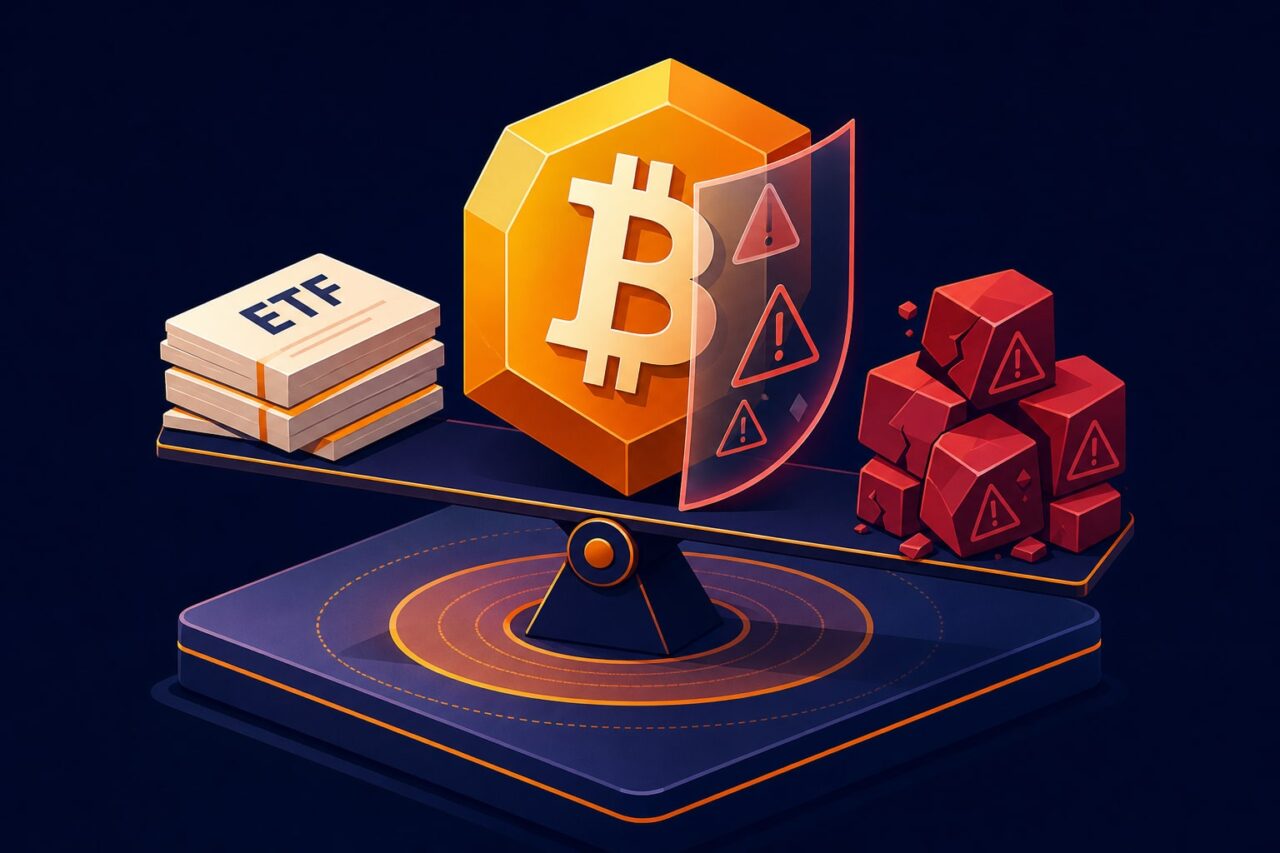
Bitcoin ETFs are in the spotlight again today with this year’s largest crypto theft of $6.3 billion, and Bitcoin ETF assets dropping to their lowest in three months. There are serious questions around security and centralization that all crypto investors should be aware of.
Historic Crypto Theft and ETF Outflows
The latest episode of Crypto Tips highlights that October has also seen the largest cryptocurrency theft ever recorded, with about $6.3 billion being withdrawn from Binance in the space of 20 minutes. This raises questions about the security of centralized exchanges, even those of the biggest names in the crypto space.
Bitcoin ETFs have also seen a drop in assets under management, down to $77.7 billion, a three-month low. Over $2.5 billion has flowed out of Bitcoin ETFs, suggesting that institutional confidence in Bitcoin ETFs may be faltering. This comes as no surprise after the recent crypto theft and the volatility of the Bitcoin market.
Centralization Risks: Coinbase and Treasury Holdings
The host of Crypto Tips brings up a potential systemic risk stemming from the concentration of assets. Most of the Bitcoin managed by ETFs is held with a single custodian, Coinbase. Should anything happen to Coinbase, a large amount of the Bitcoin managed by ETFs would be at risk.
Corporate treasuries, such as MicroStrategy, now hold more than 850,849 bitcoins, more than 4% of all Bitcoin in existence. This raises questions about decentralization and the ability of certain entities to control the market, which are key tenets of cryptocurrency.
Ethereum’s Role and Staking Concentration Issues
Ethereum remains an important network for programmable settlement and for securing tokens on secondary networks. However, there are also concerns about the centralization of the network. Lido, a staking service, is managing about 22% of all staked Ethereum, and another entity, Bitmain, is also a significant player. Centralization in this manner poses a risk to the security and decentralization of the Ethereum network.
Crypto Tips emphasizes the need for holders to not only keep a close eye on flows in and out of Bitcoin ETFs and Coinbase’s dominance in custodial Bitcoin services, but also on Lido’s and Bitmain’s share in Ethereum staking. It is important for us to understand the risks faced by the crypto ecosystem as a whole.
Security Strategies: Self-Custody vs. Centralized Solutions
The host of Crypto Tips also points out that while there are risks with ETFs and centralized exchanges, there is a possibility of exchanges like Binance compensating users for their losses with their own funds. This does not change the fundamental differences between truly owning your assets and merely having a claim to them.
In most cases, self-custody, or storing your cryptocurrency on hardware wallets, is the safest option. It requires a little more know-how on the user’s part, but eliminates systemic and custodial risks.

Understand institutional risks better by practicing risk-free trading on real markets with our simulator. risk-free trading practice.
Read also

Discussion
Comments from BuyCrypt Live. Sign in with Google or Apple — we create your BuyCrypt account on the way, the same one as in the app.