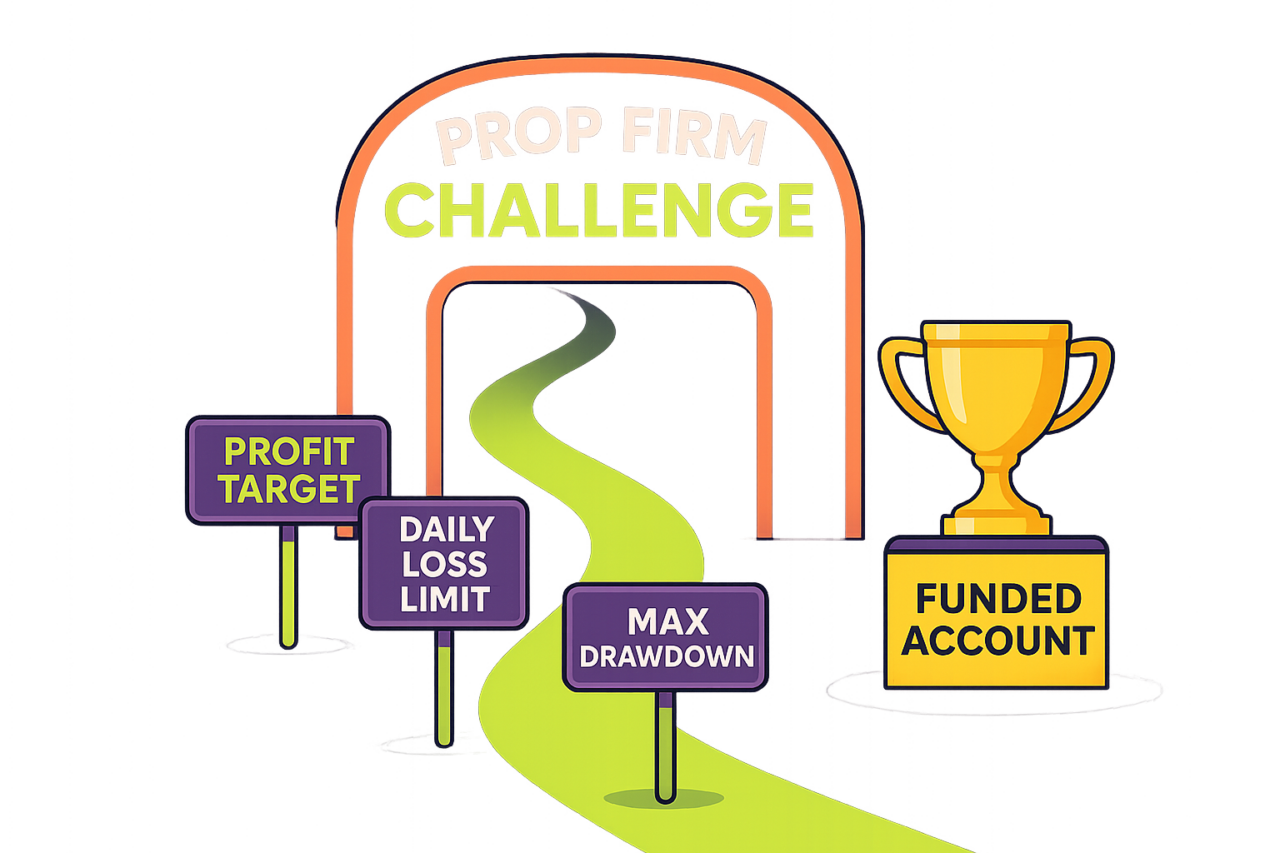
The way to get through a prop firm evaluation has less to do with calling the market and more with risk control. We put that to the test by reviewing 48 of our own simulated crypto trading tournaments. The result was unambiguous: the traders who made it were the ones who put drawdown protection first, let their gains come in at a reasonable clip, and forsook any notion of nailing the entire challenge in a single sitting.
Consider this an unvarnished playbook for the trader in need of some straight talk on prop firm challenges. There are some hard-earned tips here, along with risk examples and the kind of adjustments you have to make in a volatile crypto environment. We’re not here to sell you on anything or make empty promises. (For what it’s worth, if you want to put some of this into practice, there is BuyCrypt, a place for no-deposit, free-to-enter crypto tournaments and demo contests on live data where you can walk away with USDT. It’s not an exchange; you won’t be buying or selling there.)
The numbers don’t lie
There is nothing enigmatic about the pattern. The accounts that saw it through to the end tended to be the quiet ones. They passed on the marginal trade, they didn’t push up against the daily cap, and they sized in a way that left room for error.
Then there were the ones who couldn’t be saved. And the rub is, they often had fine entries. It wasn’t the analysis that got them. It was the exposure, the lack of discipline, and how they handled the pace.
A case study in passers and blow-ups
Some habits are common to the stronger side of the ledger. These people aren’t out to be the star of the show on every position. They just want to be in the game long enough for their edge to work.
- They stick to a set risk.
- They call it a day once a certain loss is in the books.
- They prefer to build equity over time instead of looking for the home run.
- They read the fine print of the prop rules before they even think about a trade.
- They only go after the leaderboard when the contest makes it worth the risk.
You can see the difference in the stats:
| The ones that held up | The ones that didn’t | |
|---|---|---|
| Risk | Preplanned and small | Up and down with the mood |
| After a loss | Step back | Try to make it back in one go |
| Pacing | Steady | Hectic |
| Trade quality | Only the good ones | Anything that looks like a move |
| Rules | Watched the limits | Chased the profit number |
Where it usually goes wrong
Failures in these challenges are typically a matter of “rule friction.” It’s a dry term, but it’s the reality. You can be right for a week and still be done because one rough day puts you over the drawdown line.
That is the part of the game many misread. The target isn’t the whole point. The point is to hit the target without breaking the rules of the road.
Typical mistakes
We saw them time and again.
- Oversizing too early. Wanting to get off to a quick start and using too much size before you know what you’re in for.
- No personal stop. Relying on the platform’s hard limit instead of having your own.
- Not knowing your drawdown. A trailing max can ratchet in behind your high and make you pay for being overconfident.
- Chasing the board. Feels good, but it is a poor way to survive an evaluation.
- Inconsistent sizing. When your position size is a roll of the dice, your risk profile becomes a mess.
The crypto factor
Crypto is a different animal. A funded challenge can seem under control until a fast move whips you, you get a bad fill, and you are tempted to jump back in. That is how you lose an account in short order.
To make it in a prop firm crypto challenge, you have to be more of a stickler for frequency and size than you might be otherwise. Volatility is as much a penalty for loose risk as it is a chance to make money.
How to be in the passing column
It is possible to train for this. No need for some infallible indicator. You just need a system that prevents you from making a fool of yourself.
Here is a checklist for keeping your head:
- Have the profit target in mind for the week.
- Put the total and daily drawdown limits in writing.
- Make your risk per trade a constant.
- Set a hard stop for the day well below the rulebook’s.
- Stick to one or two setups you can count on.
- Keep a lid on the total risk you have open.
- If you break a rule, write it down.
- Walk away if you are rattled.
Let’s be plain about it: the big, one-day wins are overrated. A big day in a funded challenge can be a double-edged sword. If you are bound by a consistency rule, or if a lucky run of good fortune alters your headspace, the trouble is often yet to come.
There is more to be said for steady progress. It is the sure way to maintain a stable process and, more importantly, to hold the line on position sizing.
Risk, sizing, and pacing
Put together a workable risk plan for a prop challenge and it will rest on three things: how much you put on the table per trade, what you can afford to lose in a day, and how you pace yourself to the goal. Let one of those slip and the plan falls apart.
The objective is not to have some short-lived fun with the market. It is to make as many quality plays as you can before the rules put an end to it.
Sizing up for the prop firm
When it comes to an evaluation account, a small, set risk will generally outperform any aggressive scaling. The numbers will vary with the rules and the stop distance your setup demands, but the point is to let the account see out a normal losing streak.
Here is a no-nonsense way to do it:
- Set a fixed dollar amount for risk.
- You have an off day? Scale back.
- Put a lid on how much open risk you have at once.
- Resist the temptation to size up just to catch up to the target.
Some numbers to put it in perspective
This is for illustration.
| Account Metric | Example |
|---|---|
| Demo balance | $100,000 |
| Profit to make | $8k–$10k |
| Hard drawdown | $10,000 |
| Daily limit | $5,000 |
| Per-trade risk | $400–$500 |
| Your daily stop | $1,500–$2,000 |
| Open risk max | $1,000–$1,500 |
Say you are risking $500 and you have a $1,500 hard stop for the day. You can take three of those and still be in the game. Not pretty, but you can live with it. Risk $2,000 and two bad trades will have you up against the platform’s wall. One is a process; the other is a bet.
Hitting the profit mark
Traders have a way of blowing up right when they are in sight of the finish line. They see the target is close and put on more size. That is where a lot of them go under.
Keep it simple:
- Guard your equity in the opening sessions.
- Let the setups come to you.
- Do not let the size waver as you build the account.
- When you are near the number, don’t force it.
Making the most of crypto
Just because the market is open 24/7 doesn’t mean you should be. There is an edge in being picky about the conditions, and even more in knowing when to sit on your hands. A lot of people in these challenges fail because they think they have to be in front of the screen all the time.
Timing and volatility
You will see different behavior at different hours. Liquidity dries up, momentum gets rough, news comes in unannounced. If you need a clean move and the session is a mess, you can easily find yourself in violation of the rules.
A few things to consider:
- Stick to the times that have worked for you in the past.
- Tread lightly around the big macro events.
- If the spreads are wide or the action is jumpy, cut back.
- If your records show you don’t do well on the weekend, don’t make a habit of it.
Know the rules of the road
One challenge is not like another. Some are strict on consistency; others will flag you for intraday swings or how they handle trailing drawdown. Find out what you are up against before you make a move.
With a static drawdown you have a bit more leeway if you put some cushion in early. With a trailing one, it only gets tighter as you go up, so a late retrace can be costly. Read the fine print. Then make your plan.
What to use for prep
You don’t have to buy into every piece of software out there. What you need is a way to get feedback. A journal, a contest log, some straight talk in your notes.
The best tool is the one you will turn to after a rough session, because that is when you learn.
In your journal, look for the why, not just the P&L:
- Why did you enter?
- What was the setup?
- Where is the stop?
- How much is on the line?
- What time is it?
- Did you break any rules?
- How were you feeling?
- Did you honor the daily stop?
The value of a simulated contest
There is no point to practice if it is done in a vacuum. A paper plan put together when the going is easy has a way of falling apart when you are up against hard time limits, ranking systems and drawdown rules. Simulated contests put an end to that by putting some pressure on your process. You will see where your pacing is off, if you have a habit of overtrading or a need to chase.
BuyCrypt is a good option for this kind of work. The platform puts on free crypto trading tournaments and demo contests using live market data, with real USDT on the line for those who come out on top. No deposit is needed. It is a way to put your execution, journaling and headspace to the test without any of the risk. (For the record, we are not an exchange and do not deal in the sale of crypto.)
Assembling the plan
How does one get through a funded challenge? When you get down to it, the answer is straightforward. Keep the size of your trades to a level where you can endure them. Be picky about what you take so as to steer clear of subpar setups. And let the rules have the final say, not your ego.
Some might find that too plain. It is as it should be. The most effective plans are.
A week in the life
- Stick to a couple of setups you know.
- Decide on a set amount of risk for each trade at the start of the week.
- Put a number on your personal daily stop loss; make it lower than what the platform allows.
- Limit how much you have open at once.
- Go over every session, paying close attention to any rule you may have bent or an emotional call.
- If you have a day where you are not at your best, slow things down. Do not try to put it right on the spot.
- Run some drills on a demo balance or in a tournament before you go for it again.
Then there is this: a funded challenge is as much about self-control as it is about reading the market. Many a trader can look at a chart. Not as many can tell themselves to stand down. Those are the ones who stick around.
FAQ
What is the surest way to clear a prop firm’s hurdle?
Discipline with your risk. Sizing should be fixed, you should have a personal stop for the day, and you should only be in the water with your top-tier setups. Do not force the profit target.
How much is too much to risk in a single trade?
It depends on the strategy and the fine print of the challenge. But as a rule, a conservative approach is more sustainable. It is better to be able to weather a run of losses than to be on the edge of a drawdown limit.
Why do some with good setups still miss the mark?
They are usually undone by what they do around the setup. We see it with oversizing, revenge trades, or when the daily drawdown is breached. The problem is rarely the setup itself.
Is the prop game tougher with crypto?
In some ways. The 24/7 nature of it and the volatility can be unforgiving if your position sizing is weak. That is why you have to be even more deliberate with your sessions and your stops.
Are demo contests any use for getting ready?
Provided they have some teeth to them and are based on real data, yes. They are a good place to work on your drawdown discipline and how you handle a trade. You can find some of that with BuyCrypt’s free simulated tournaments and demo play, where we offer USDT prizes and require no deposit. We are not an exchange, however, and do not facilitate the purchase of crypto.
Keep reading: trade to win crypto · join the demo contest · How To Win Crypto Trading Competition
Every major exchange tournament: what is live now, announced vs distributed prize pools, history since 2020. Updated nightly.

Автор Benjamin Redfern
I was born in 1979 in Dunedin, New Zealand, where cold mornings, steep streets, and strong opinions about rugby were part of ordinary life. I use Benjamin Redfern as my public name. My private identity remains known only to close family and long-standing friends.
Discussion
Comments from BuyCrypt Live. Sign in with Google or Apple — we create your BuyCrypt account on the way, the same one as in the app.