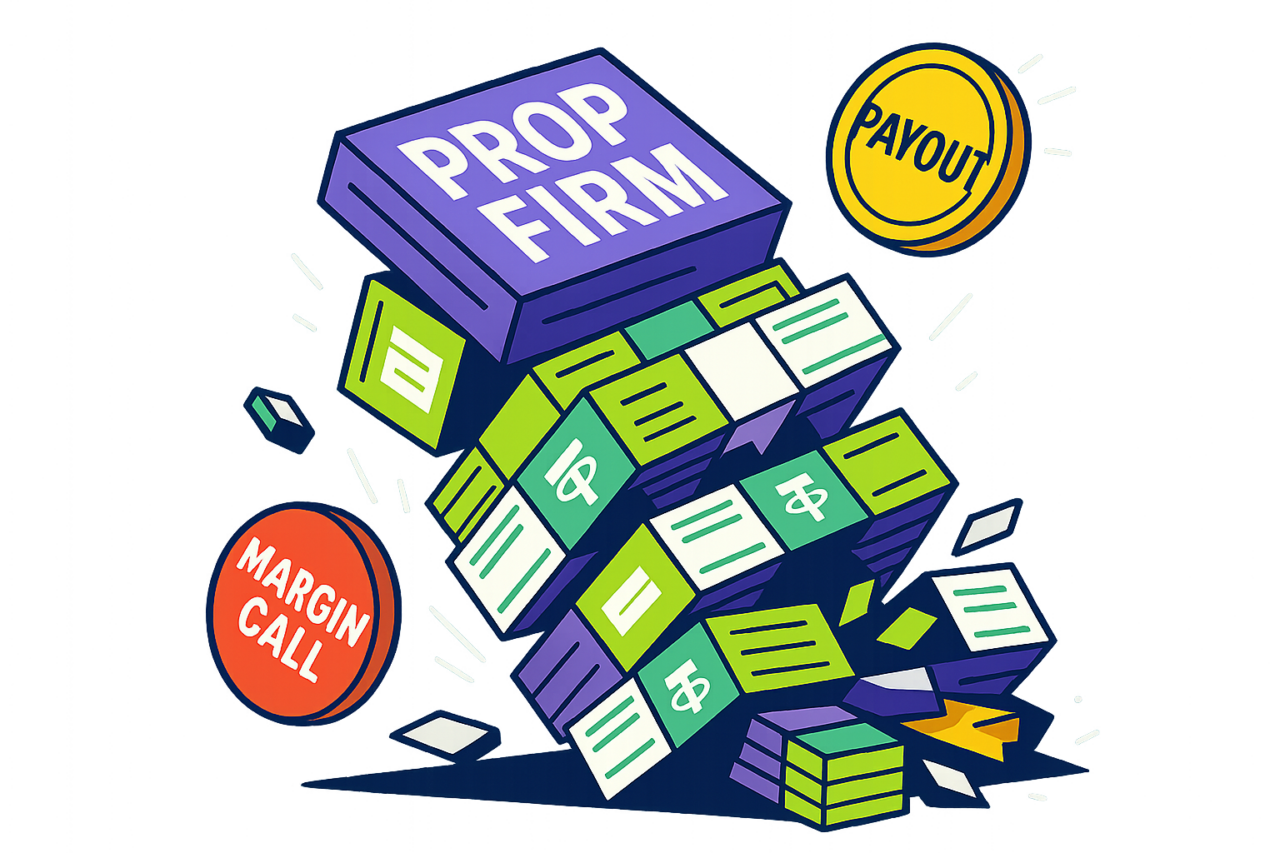
With the prop firm collapse in their wake, traders are left to wonder if they will see a payout from their prop trading. Some will, yet the 7% figure that is bandied about is not some kind of universal success rate; absent well defined data it is of no real consequence.
What has become of prop firms?
A host of retail prop trading failures, shutdowns and platform departures have been put on record by VeritasChain and Finance Magnates Intelligence. One will hear estimates of as many as 100 or 80 firms having gone under, though the number is a matter of how one defines “collapsed”.
For some it was a total closure. For others there was an end to payments, a loss of access to the platform, a retooling of the business model or they simply went off the public radar. A formal bankruptcy is not the only form a shutdown can take.
The typical retail prop firm puts an evaluation or challenge up for sale. Put in a fee and trade within the parameters of a maximum drawdown and daily loss limit and you stand to qualify for a funded account. More often than not the account is simulated, not backed by live market capital.
There is revenue to be made from those who do not make the grade. Not every firm is dishonest for doing so, but a conflict is introduced when the business is more reliant on evaluation fees than the trader’s performance.
MetaTrader Licensing
MT4 and MT5 are the products of MetaQuotes and a good deal of the customer experience at forex and crypto prop firms is built on them, from order interfaces and charting to trade history and reporting.
Firms with a heavy reliance on these tools were put under strain when MetaQuotes made certain licensing moves in the sector. That meant pausing operations, putting in new software or relocating traders.
It is a practical lesson in independence. A prop firm might seem self sufficient but is in fact beholden to outside parties for its broker connection, payment processing, market data and the like. Should that link break down, expect delayed withdrawals or no access at all.
- Identify the legal entity behind the platform.
- Find out if your trades are live, copied or just a simulation.
- Know what the plan is should TradingView or MT5 go dark.
- Get written confirmation of a migration and payout policy.
The 7% Figure
There is a claim that 7% of traders are the ones who get paid. But that is a hasty conclusion. The numbers are only as good as the group you are measuring.
| Possible denominator | What it measures | Why it can mislead |
|---|---|---|
| All challenge purchases | Accounts that received a payout after entry | Repeat buyers are counted more than once |
| First-time traders | New customers who eventually withdrew | The period of measurement may be too short |
| Funded accounts | Payouts among accounts that passed | Failed challenges are excluded |
| Payout requests | Approved payouts | Denied or canceled requests may be missing |
| Active traders | Approved payouts among active traders at a given time | Former customers will not show up |
A 7% stat may be a narrow sample, or it may be counting accounts and not the person behind them. A single trader can put money down on a number of challenges, fail most and pass one.
Ask then what percentage of traders receive a payout and there is no industry standard to give you. It is a question of rules, timeframe, account type and what the firm considers a “payout.”
Better to look for a firm that can put forward evidence of consistent approved withdrawals and has rules to back up its advertising, and can account for any denials.
Legitimacy in Prop Trading
Prop trading is legitimate enough, but the term applies to quite different enterprises. A dashboard and a website with a simulated balance are no proof of trading the company’s own capital.
Before parting with money make the distinction between:
- A traditional proprietary company that employs traders and uses its capital.
- A retail evaluation firm making money on challenge fees for a simulation.
- A regulated broker offering market access.
Most day trading prop firms are of the second sort. They will have a profit split and a demo balance but you do not own that capital and they are not a regulated investment manager.
Be wary of undefined risk clauses used to deny a payout, trailing drawdown calculations that are opaque, or rules subject to change once you have passed. Marketing that makes of simulated funds something of your own, or withdrawal terms you have to wade through pages to find, are also cause for concern. Do not think of a prop firm challenge as free money; the evaluation fee is an expense you can lose.
Then there is the matter of My Forex Funds. The dispute with Traders Global Group, Edward S. Kiel and Jose L. Linares has drawn more than its share of attention as a legal case in the sector. An enforcement action was initiated by the CFTC only for a federal court to put an end to it. The fact of the dismissal is significant, yet one should not overstate its import. It is no proof that all prop firms are above reproach or that their traders have been made whole, nor does it invalidate every worry about the sector. A case can be thrown out on the basis of jurisdiction, procedure, the evidence at hand or the claims themselves.
The matter also underlines the need to read legal status with care. There is a difference between what a company puts on its homepage and what customers think they are doing when they put up capital; in the fine print of an agreement you will see if they are really a technology or evaluation provider.
Rule 4.7 And The Legal Debate
Under CFTC Rule 4.7 there is relief for registered commodity pool operators, trading advisers and other qualified eligible persons. One would be wrong to see it as a carte blanche for any retail prop firm.
Then there is the question of whether some of these enterprises are more akin to gambling than a conventional financial service. The rules are such that a trader is paying for an outcome and most don’t make it, and the firm isn’t obliged to put every trade in the live market.
Depending on how they handle pricing, transparency and payouts, the arrangement can be seen as either educational or something to exploit. It is well to let regulatory scrutiny prompt a closer look at the business model.
How To Check A Firm
Take time to examine the contract and how a payout is done in practice before handing over an evaluation fee. A few words can be the difference between an account making it through volatility and not.
| Check | What to look for | Why it matters |
|---|---|---|
| Legal identity | The registered name and governing law | Tells you who is on the hook |
| Trading model | Whether trades are simulated, copied or live | Gives meaning to “funded” |
| Drawdown rules | Total, trailing or daily loss | Sets the terms for an account’s demise |
| Payout policy | The conditions, minimums and denial process | Shows you what to expect from a withdrawal |
| Track record | Dated proof of payout and how complaints are handled | Is worth more than a promotional image |
| Platform dependency | Use of MT4, TradingView or another provider | Can expose where a firm is likely to falter |
Dated records and sensible answers to complaints are of more use than a single screenshot. You won’t find a public list to vouch for which firms pay out, as operations and policies are subject to change.
BuyCrypt’s Practice-First Model
In contrast to a paid challenge, BuyCrypt has its own way of doing things. There are no deposits required to put in for USDT prizes in its free crypto tournaments and demo contests, which run on real market data but are simulated.
One wouldn’t call it a cryptocurrency exchange since there is no buying or selling of crypto. It is meant to be a gamified exercise in education, to test one’s decisions and measure them against the rules.
For those looking into prop firm payouts, it is a useful alternative; a free contest (or one with a $5 price tag) means no evaluation fee and no personal deposit at risk. Where possible BuyCrypt will provide on-chain proof of payout.
But check the eligibility, rankings and withdrawal requirements first. Simulated results do not equate to income, plain and simple.
What Traders Should Remember
To say “7% of traders get paid” or that the whole lot are scams is to make a slogan of a complex business. Some do get their money from prop firms. Others are left high and dry after a disputed withdrawal or the firm closes its doors, or they simply don’t pass the challenge. Verify the entity, the drawdown numbers and the payout clauses. Don’t mistake a demo balance for your cash.
FAQ
Do prop traders get paid?
Some do, though the rate will vary according to the firm and how one measures it. A screenshot of a payout is not evidence that an account type can count on getting its money in a timely fashion.
What of the 7% figure?
Unless the source lays out the sample and timeframe for its calculation, it is not an industry wide statistic. It may pertain to funded accounts or challenge purchases in a given period.
Are they legit or a scam?
You will find legitimate evaluation businesses and then those with less than honest disclosures or poor practices when it comes to paying out. Do your due diligence on the legal entity and the rules before you part with any money.
Where are the risks in a payout?
There is the matter of denied withdrawals, a company folding, an outage on the platform, or rule changes that are open to interpretation. Breaches of a trailing drawdown or hitting a daily loss limit are among the usual perils. And the balance you see might be simulated, not cash put aside for you.
Is BuyCrypt a prop firm or crypto exchange?
BuyCrypt is not an exchange, nor does it deal in the sale of crypto or put any deposit conditions on those who wish to take part. The company puts on its own demo trading contests and crypto trading tournaments at no cost, all with real market data behind them.
More from BuyCrypt: on-chain payouts · get funded to trade · the $5 challenge
Every major exchange tournament: what is live now, announced vs distributed prize pools, history since 2020. Updated nightly.

Автор Benjamin Redfern
I was born in 1979 in Dunedin, New Zealand, where cold mornings, steep streets, and strong opinions about rugby were part of ordinary life. I use Benjamin Redfern as my public name. My private identity remains known only to close family and long-standing friends.
Discussion
Comments from BuyCrypt Live. Sign in with Google or Apple — we create your BuyCrypt account on the way, the same one as in the app.