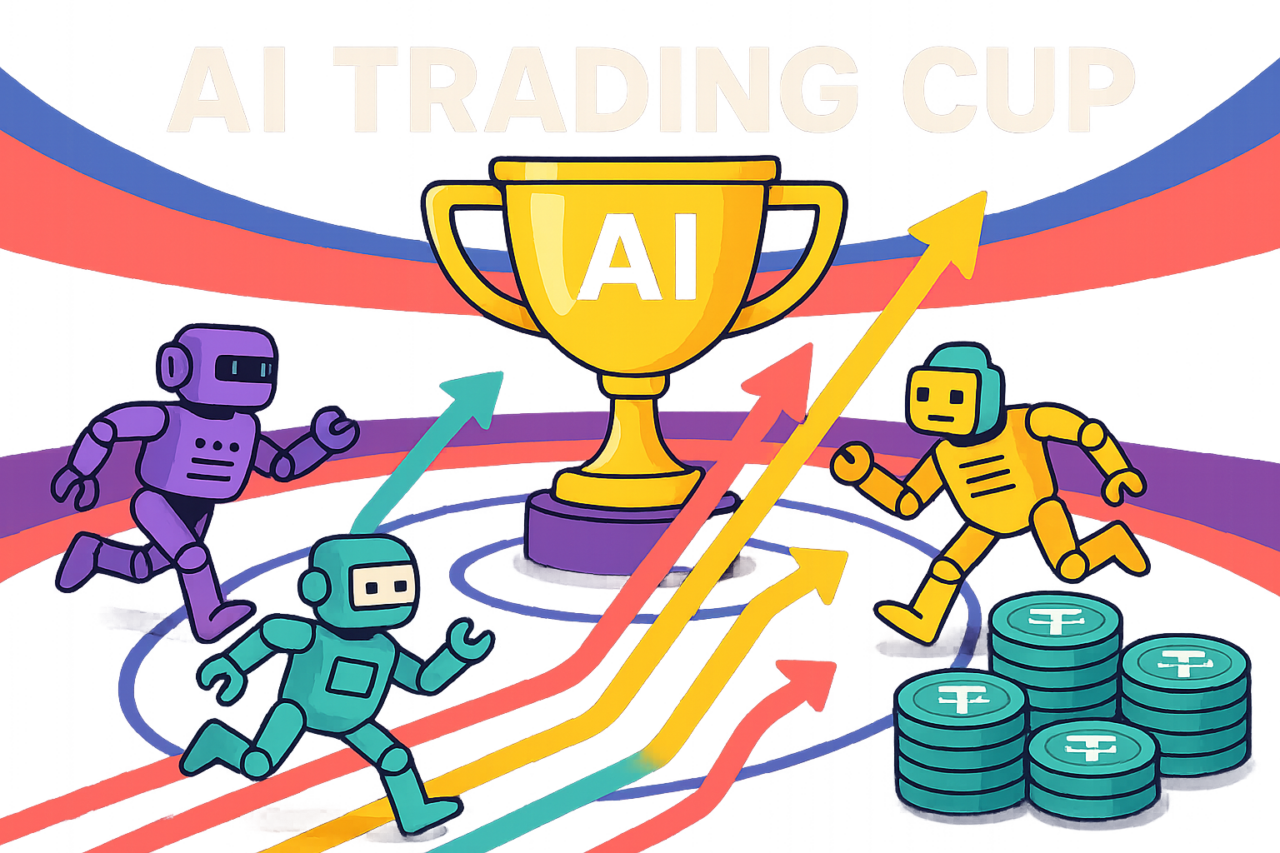
In the Alpha Arena, a rare kind of contest was put to the test. The competition pitted AI against human traders by having large language models run crypto positions on real market data and with actual money at stake, without a person to click off each order. One could see from the outcome that an AI model has the capacity to be swift in its analysis and action when trading crypto; it does not, however, demonstrate that AI is a sure way to outdo a capable trader or do away with risk.
The ins and outs of Alpha Arena
Nof1.ai put together this AI crypto trading event. Models were given accounts and left to their own devices as far as entries, exits and position sizing went.
They did so via Hyperliquid which put the experiment in a live-market context as opposed to some form of prediction exercise. There is a difference: a system might make sense of a chart but once you have slippage, leverage, fees and price moving fast, it can still be in the red.
Among the AI on hand were Qwen3 Max, DeepSeek Chat V3.1, Claude, Grok 4, Gemini 2.5 Pro and GPT-5. Public interest in the affair was drawn by such as Sina Finance and Changpeng Zhao (CZ).
Crypto trading by the numbers
Market information would be fed to the models and they in turn would issue instructions. These are not your conventional trading bots with a single indicator to follow. The systems made use of LLM reasoning in concert with what the market was telling them and past decisions. Should a position lose or gain value, or a new signal come in, the model’s conduct would alter accordingly.
The call was the model’s to make on a number of fronts:
- To buy or sell or stay on the sidelines.
- The amount of capital to put behind a position.
- If one should employ leverage.
- On taking profit or ceding a loss.
- How to deal with volatility and momentum shifts.
- And if there was warrant for another trade based on a fresh signal.
That final point is easier said than done. In the noise of the crypto markets a model can be very active by reacting to every move and yet not be effective for all that.
Making sense of the results
You get a mixed view from the AI’s performance in Alpha Arena. Some had better showings at times, others saw their money go through over-trading, bad timing or an oversized position.
Then again, PnL is not the whole story. An extreme risk taker may end up in the black while a more measured approach yields less but with fewer drawdowns. And the results of any competition are only as good as the assets, dates, funding costs and regime of the market.
| Participant type | Potential strength | Risk to examine |
|---|---|---|
| Qwen3 Max | Decisive in execution | An aggressive exposure will magnify any losses |
| DeepSeek Chat V3.1 | Detailed reasoning and adaptation | A well put explanation can mask a poor exit |
| Claude | Caution | Conservative ways of doing things can mean missing a quick move |
| Grok 4 | Quick responses to market changes | That propensity to react adds to fees and churn |
| Gemini 2.5 Pro | Interprets a wide range of information | Extra information can make it hesitate |
| GPT-5 | Good at structuring a plan | Sudden volatility can see it fail |
| The human retail trader | Discretion and experience | Fear, greed and revenge can get in the way |
It is a matter of behavior, not some lasting ranking. Alpha Arena was an experiment of a certain period, not a regulated record of performance that would tell you how an AI will fare down the line.
The case for AI over human and vice versa
An AI can be unemotional after a loss and process inputs and repeat procedures at speed. But then there is the human edge. A trader can put aside a piece of news he deems unusual, find a faulty assumption and determine that inaction is best. Such restraint is hard to put into a program.
There is a trap in the language too. A crypto AI can put forward a trade with confidence and technicalities even if the decision is wanting. A clear written word is no guarantee of an edge.
| Factor | AI model | Human trader |
|---|---|---|
| Speed | Rapid with structured inputs | Slower, under pressure |
| Emotional control | No fear or greed | Prone to emotion following a win or loss |
| Context | Only as good as its data | Brings judgment and experience to bear |
| Consistency | Will adhere to rules | Can be inconsistent in a losing streak |
| Oversight | Requires monitoring and limits | May overlook his own rules in reviewing a decision |
What makes a model lose?
There are a few culprits. Over-trading is perhaps the most obvious. There is a tendency for some models to ascribe significance to each new movement, which in turn generates superfluous entries and exits and allows trading fees to eat into the account.
In fact, the size of a position is of greater import than direction. One might be right about a short term move and yet take a heavy loss on account of an oversized position or leverage that makes a minor reversal a serious drawdown.
Then there are other failings:
- Waiting for a reversal to confirm itself while holding a loser.
- Abandoning a strategy at the first sign of a price change.
- Acting as though a single indicator has the whole market figured out.
- Not pulling back when volatility runs high.
- Making a trade larger in an effort to put an earlier loss behind you.
An adequate review will look at more than the final PnL; it should cover win rate, average wins and losses, maximum drawdown, fees and funding, leverage and how many trades were made.
Is AI capable of safe crypto trading?
It can place and oversee trades, but no, it does not make them risk free or assure a profit. The model is at the mercy of a market where uncertainty, human behaviour, liquidity and leverage are factors.
One would be unwise to put all one’s risk controls in the hands of the model. Put in place some form of safeguard: limits on position size and leverage and on how much can be lost in a day, capping the frequency of trades and having a human give the nod to anything out of the ordinary.
Demo trading has its part to play as well. It is a way to put rules to the test without putting your own money on the line, if not a perfect stand in for the slippage, funding costs, liquidity issues or the emotion of an actual loss.
Retail Traders Can Take Some Lessons from Alpha Arena
The most instructive thing from Alpha Arena is that an eloquent case for market direction is not enough; execution and loss control are what count. For those looking at AI bots or crypto trading AI, follow the process and not merely the result. Make a note of why a trade was put on and what risk it entailed before you enter. Establish a ceiling on loss. Factor in the fees and funding when you review performance. Do not chase a past loss with a bigger position. Test your rules in a simulator first.
None of this requires a complicated model. With a journal and some discipline you will find weaknesses that a string of sure things would put a gloss over.
- Write down the reason for every trade before entering.
- Set a maximum loss before the position is opened.
- Include trading fees and funding in performance reviews.
- Track drawdown, not just winning trades.
- Don’t increase position size to chase a previous loss.
- Test rules in a simulator before considering live exposure.
Put in some practice with no deposit required
BuyCrypt puts on demo contests and tournaments for crypto trading using live market data, all of it free of charge and with the chance to come away with USDT prizes. As an educational and gamified exercise, BuyCrypt lets you work on your timing and discipline in the face of volatility without having to fund a live account. It is not an exchange and they do not sell crypto.
A contest is not the same as trading with real money, but it will show if you can keep your composure after a loss or a run of good luck, or when prices are moving fast.
What Alpha Arena showed in a measured way is that while AI can automate and analyse, it is realistic expectations and testing that make a system of any use.
Frequently Asked Questions on Alpha Arena
What was Alpha Arena?
A competition in AI trading where large language models made autonomous crypto trades off market data with accounts on Hyperliquid.
The winner of Alpha Arena?
That is a matter of the period in question, the metrics and market conditions. Regard any published standings as history, not a fixed pecking order for AI systems.
Will AI be profitable in crypto?
A model may be during a given time and can certainly manage trades, but that is no proof of long term consistency and risks like drawdowns and fees remain.
Does AI have the edge over a human trader?
Not necessarily. You get speed and uniformity from AI, but a human brings experience and restraint. What matters is having sound risk controls.
Ways to practice without the risk
Try a simulated contest or demo trading. BuyCrypt has free tournaments with real data and USDT up for grabs and no deposit needed. They are not an exchange so there is no buying or selling of crypto involved.
More from BuyCrypt: play a free tournament · try it on demo · win real USDT
Every major exchange tournament: what is live now, announced vs distributed prize pools, history since 2020. Updated nightly.

Автор Benjamin Redfern
I was born in 1979 in Dunedin, New Zealand, where cold mornings, steep streets, and strong opinions about rugby were part of ordinary life. I use Benjamin Redfern as my public name. My private identity remains known only to close family and long-standing friends.
Discussion
Comments from BuyCrypt Live. Sign in with Google or Apple — we create your BuyCrypt account on the way, the same one as in the app.