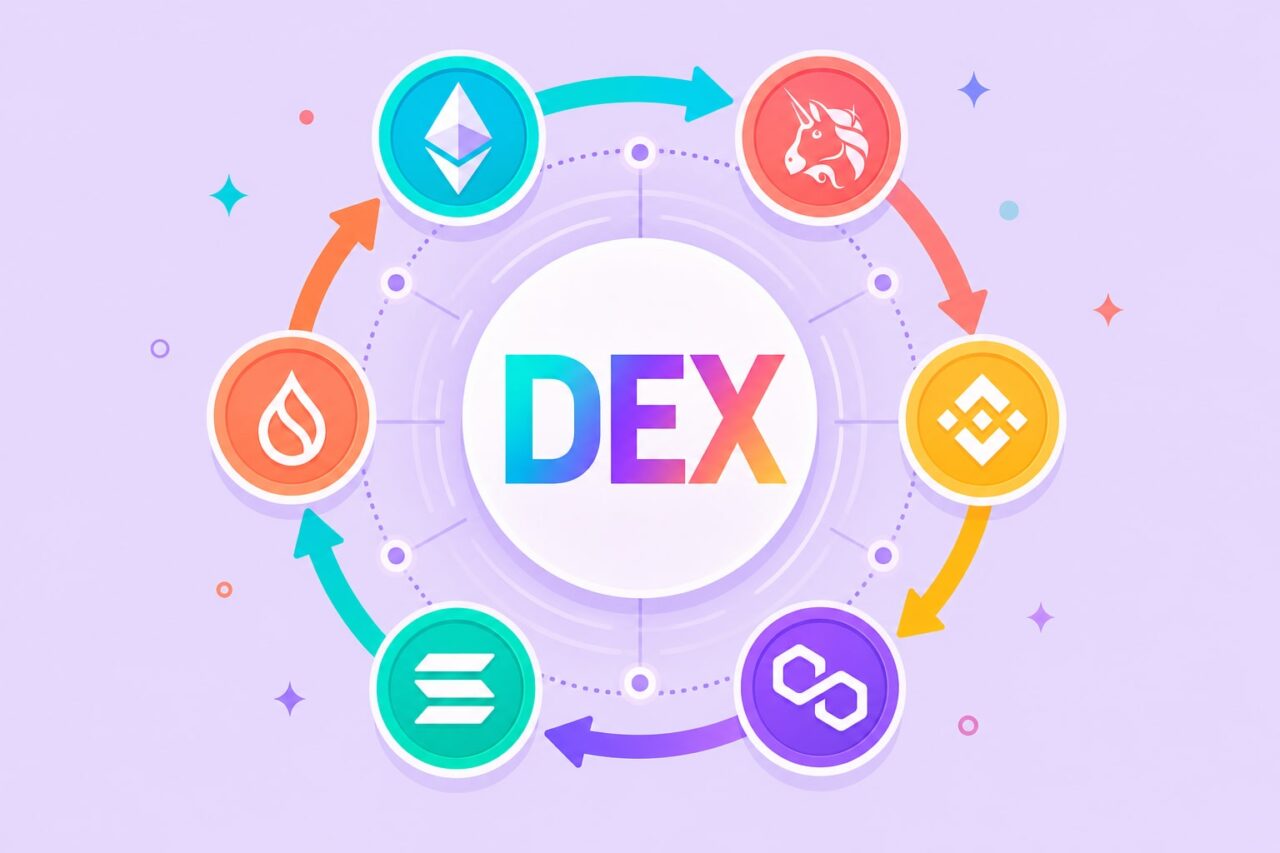
A decentralized exchange, or DEX, allows you to trade crypto from your own wallet via smart contracts on the blockchain. This guide explains how a decentralized crypto exchange works and dives deeper into the various ways that trades are carried out on DEXes, including AMMs, order books, perpetual DEXs, and aggregators. We also touch upon the differences between DEXes and centralized exchanges.
What Is a Decentralized Exchange?
A decentralized exchange is a blockchain application that facilitates non-custodial crypto trading. The trader simply connects a wallet that is compatible with the DEX, selects the assets they want to trade, and approves the transaction. The smart contracts on the DEX then execute the trade as per the instructions they are programmed with.
Generally, users do not create traditional accounts on DEXs or deposit funds into company-controlled wallets. Instead, they retain control of their private keys and assets. This makes DEX trading safer in one sense, but it also means you are solely responsible for any mistakes you make.
Decentralized exchanges allow users to do a variety of things, such as:
- Swapping one crypto asset for another
- Providing liquidity to trading pools
- Using market or limit orders
- Trading perpetual futures
- Finding routes across multiple liquidity sources
This article will cover the various technologies and their trade-offs. If you want to learn more about the best decentralized exchanges in 2026, be sure to look out for our upcoming guide.
How Does a Decentralized Exchange Work?
A decentralized exchange has many of the same core functions as a traditional exchange, but instead of trading on a custodial account, you use a wallet and smart contracts. Trading takes place on the blockchain and liquidity is provided to pools that are governed by smart contracts.
The exact process differs between DEXes. Automated market makers use liquidity pools to price swaps, while order-book DEXes match buyers and sellers. Aggregators search multiple sources of liquidity to find you the best deal.
The steps you will typically go through on a decentralized exchange are:
- Connect your wallet to the DEX’s interface.
- Select the token you wish to sell and the token you want to receive.
- Review the trading rate and fee, and the gas fee you will pay. Review the price impact of your trade and your slippage tolerance.
- Approve the token if you haven’t done so previously.
- Confirm the transaction or order.
- Wait for the transaction to be processed and confirmed on the blockchain.
Since DEXes are decentralized, they are typically not able to reset your wallet password or reverse your transactions, so they have no way to recover funds you send to the wrong address. While trading on a DEX is convenient, it also means you must take responsibility for your own actions.
AMM Decentralized Exchanges Use Liquidity Pools
Automated market makers allow traders to swap tokens using liquidity pools instead of matching with other traders. Liquidity providers can deposit assets in these pools to generate a share of the trading fees.
Uniswap helped popularize the constant-product model, whereby AMMs use a formula to determine the price of various token pairs based on their relative balance in the pool. This means that if many people try to buy a particular token, its price will rise, as its balance in the pool decreases in relation to the other token. This price change is called price impact.
Other AMM DEXes like Curve are designed for trading between different tokens with similar value, such as different stablecoins or wrapped tokens. PancakeSwap is another prominent example of an AMM that is used for trading and providing liquidity.
AMM DEXes are often easier to use than other types, but the price that they show for your trade is only an estimate, and may change by the time your transaction is confirmed. It may change due to price movement, network congestion, or if the trade is too large for the slippage you have set.
| AMM factor | What it means for traders |
|---|---|
| Liquidity in the pool | If the pool contains a lot of assets, then there will be less price impact. |
| Slippage | The actual trading rate may differ from the price displayed by the DEX. |
| Trading fee | AMMs will typically charge a trading fee, in addition to the gas fee paid to the blockchain. |
| Impermanent loss | This is a risk faced by liquidity providers. |
| Smart-contract risk | As with all DEXes, there is a risk that the code may have bugs or be designed in a way that can be exploited. |
When using an AMM DEX, it’s important to be aware of the risks associated with Miner Extractable Value, or MEV. This allows traders to take advantage of the order in which transactions are included in blocks, which may result in your trade being executed at a worse price due to front-running and other practices.
Order-Book and Perpetual DEXs
Some decentralized exchanges use an on-chain order book to allow traders to submit their buy and sell orders and match them with others. This is similar to how centralized exchanges operate.
Order-book DEXes can allow users to submit market and limit orders like on a traditional exchange. The main downside to using an order book is that putting all of the order information on the blockchain can be expensive and slow, so many order book DEXes use specialized networks or off-chain components to improve performance.
A perpetual DEX is designed to allow users to trade perpetual futures, a type of crypto derivative without an expiration date. Examples of perpetual DEXes include Hyperliquid and dYdX. These DEXs allow users to trade derivatives with margin, funding payments, and liquidation thresholds, where users borrow assets.
Perpetual trading is different from spot market trading. A user can get their position liquidated if they don’t have enough collateral to cover their margin requirements. Make sure to read up on the rules of the perpetual DEX you choose to trade on.
How DEX Aggregators Find Better Trading Routes
A DEX aggregator is a platform that scans liquidity from several sources to find the best route to execute a trade. The aggregator may split a single trade into several different liquidity pools or use an intermediate token to provide a better route.
1inch, Jupiter and CoW Swap are just a few examples of protocols that have a focus on routing and aggregation. These platforms look for the best liquidity, fees, and price impact to help execute a better swap.
For example, to swap from Token A to Token B, a better price may be achieved by using Token C as the intermediate token. This is one example of how DEX aggregators help users get better trading routes.
Even though DEX aggregators find better routes for your trades, they do not eliminate the risk of your trade. In fact, these trades may require a user to use several liquidity pools and smart contracts, meaning that your trade may require several different transactions on the blockchain. Risks such as network congestion, price changes, failed transactions, and even smart contract issues are still factors that can affect your trade.
What are the Main Differences Between a DEX and a CEX?
A CEX is a centralized exchange while a DEX is a decentralized exchange. A CEX is controlled by a company that manages custody of funds, account access, trading execution, and compliance. On the other hand, DEXs have most of these processes controlled by wallets, smart contracts and the blockchain. Here is a summary of the main differences:
| Feature | DEX | CEX |
|---|---|---|
| Custody | User controls the assets. | CEX controls the assets. |
| KYC | Usually only requires basic KYC, wallet interaction. | Usually requires KYC. |
| Trading execution | Smart contract execution. | Trade execution by centralized order books and settlement systems. |
| Fees | You pay gas fees, and trading, routing, or protocol fees. | You pay trading fees, withdrawal fees, etc. |
| Slippage | Depends on pool depth and trade size. | Depends on order book liquidity. |
| Risks | Wallet and smart contract risks, MEV, token risks. | Custody and account restrictions, counterparty risk, etc. |
While DEXs may be more secure from a custody perspective, they do introduce other risks related to wallets and smart contracts. CEXs may be more familiar to a user, but users need to trust the CEX with custodial access and account control.
How Does a DEX Swap Actually Execute?
To give a basic overview of how a DEX swap works, lets look at swapping tokens to get USDC. The first step in the process is that the DEX reads the pool or order book data to determine the estimated output for your swap. The user will then be able to see the price impact, gas fees, trading fees and other parameters of the trade like the slippage limit.
The next step is to approve the swap. When you approve a token, the smart contract will get permission to spend a specified amount of tokens in your wallet. If the trade does not get approved, then the next step will not happen.
The user will then confirm the swap, at which point the signed transaction will be added to the pending queue on the blockchain. The smart contract will then check the conditions of the trade and execute the swap. If the price has changed more than the slippage limit, then the transaction will fail.
Once the swap is complete, the user will receive the tokens output after fees from the trade. However, there are many factors in a DEX swap that can cause the transaction not to execute. For example, gas fees, network congestion, liquidity, token approvals, and timing of a transaction can all have an effect on whether your swap executes.
DEX Trading Without Capital
One of the easiest ways to understand DEX trading is to practice it. BuyCrypt offers free crypto trading tournaments and demo trading contests at /free-crypto-tournaments and /en/tournaments/. Here, traders can trade a simulated balance with live market data and win real USDT prizes without depositing any money.
BuyCrypt is an educational and gamified platform for crypto traders. The platform is not a DEX, does not sell crypto or execute trades in your wallet. You can check out BuyCrypt’s crypto trading simulator at /crypto-trading-simulator and learn more about demo trading at /guides/crypto-demo-trading-explained.
In case you’re interested in comparing spot and futures trading contests, you can check out /guides/futures-vs-spot-crypto-trading-competitions and /guides/how-crypto-trading-competitions-work. BuyCrypt also has prop plans for 49 USDT or you can get access to them for free by joining The Ladder tournaments. After the tournament, you will be evaluated for a $5000 funded account, with an 80% profit split and USDT payouts which are confirmed on-chain.
As you can see, crypto trading contests are a simulated, skill-based trading competition. They are no guarantee to help you make profits or make up for the risks of live trading. If you would like to practice trading on DEXs, check out our article on DEX trading competitions.
Frequently Asked Questions
What is a DEX in crypto?
A DEX, or decentralized exchange, is an application on the blockchain that enables a user to trade cryptocurrencies via smart contracts. Unlike centralized exchanges, a user does not need to deposit their funds, instead they can use their own wallets to trade on a DEX.
How does a DEX make money?
DEXs earn money via trading fees, routing fees or any other protocol fees. The liquidity providers of DEXs also earn a portion of the trading fees of the pool.
Are DEXs safer than CEXs?
Not automatically. While DEXs help reduce some custody-related risks, they have their own, such as smart contract bugs, wallet user mistakes, MEV, risks related to specific tokens, gas costs, and irreversible transactions. CEXs come with their own custody and counterparty-related risks.
What is impermanent loss?
Impermanent loss happens when the assets in your liquidity pool change in value relative to holding them separately. It becomes permanent if you withdraw your liquidity.
Do decentralized exchanges require KYC?
Many DEX interfaces do not require KYC to interact with your wallet. Depending on the service and the jurisdiction you’re in, different DEX interfaces and product types may have different requirements. Be sure to check before using any.
What is a Decentralized Exchange: DEX Guide
Discover what a decentralized exchange is, how AMMs, order books, perpetual DEXs, and aggregators work, and how DEXs compare to CEXs.
Related on BuyCrypt: practice risk-free · En/Tournaments/ · free tournaments
Discussion
Comments from BuyCrypt Live. Sign in with Google or Apple — we create your BuyCrypt account on the way, the same one as in the app.