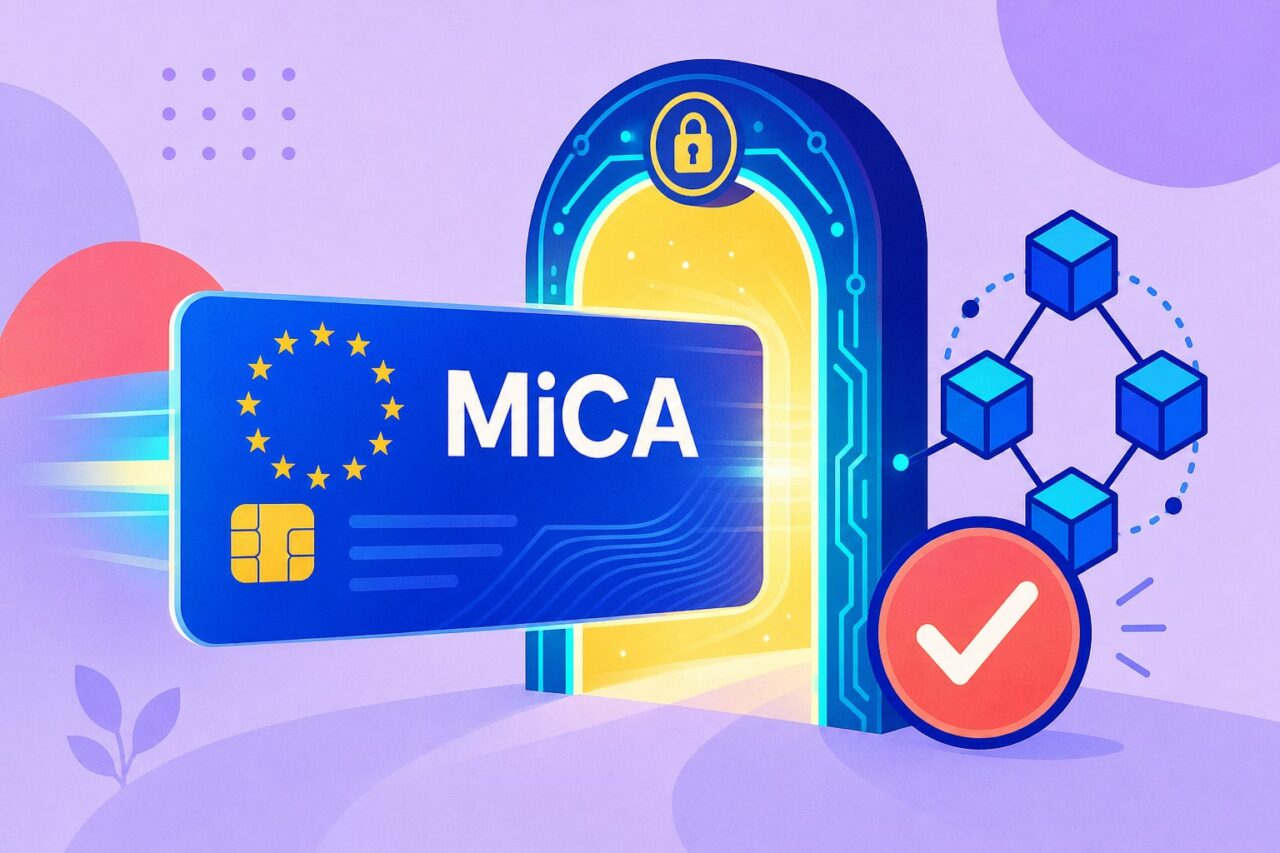
A MiCA crypto license is an authorization granted in the European Union to provide crypto services covered by the MiCA regulation. It enables you to see which national regulator is responsible for the crypto service provider, the services they provide, and whether they can make use of the MiCA passporting arrangement within the European Union.
What Does the MiCA Authorization Cover?
The Markets in Crypto-Assets Regulation, also known as MiCA, establishes a common regulatory framework for businesses offering crypto-related services within the EU. It applies to companies that provide services like the custody of crypto-assets, operation of a crypto exchange, crypto order execution, crypto-asset transfers, and management of trading platforms for crypto-assets.
To legally offer these services, a company is generally required to obtain authorization as a Crypto-Asset Service Provider (CASP) from the relevant national competent authority. While the European Securities and Markets Authority (ESMA) plays a role in the regulatory framework and publishes relevant information on the official register, it is not responsible for directly issuing CASP authorizations to individual firms.
The MiCA authorization is specific to the crypto services that a business is approved to offer. If a crypto exchange is authorized as a CASP to provide custody services, it may not have approval to offer services such as crypto investment advice or portfolio management. In addition, obtaining a MiCA license does not imply that a firm is solvent, secure, or free from losses as a result of its trading activities.
Which Firms Need CASP Authorization Under MiCA?
MiCA generally applies to businesses offering crypto-asset services to customers in the EU. Whether a company requires CASP authorization depends on its legal structure, the products and services it offers, its customer base, and the specific activities it performs.
- A CASP authorization is generally required for crypto exchanges with custodial services, which hold customers’ crypto-assets on their behalf.
- Crypto trading platforms that match buy and sell orders for crypto-assets
- Crypto exchanges that offer the exchange of crypto-assets for fiat currency or other crypto-assets
- Brokers and other firms that execute crypto orders on behalf of customers
- Providers of transfer services for crypto-assets
- Companies offering advice or portfolio management services for crypto-assets
MiCA also extends its regulatory framework to certain token issuers. Stablecoins that are classified as e-money tokens (EMTs) or asset-referenced tokens (ARTs) are subject to specific regulations regarding reserve management, disclosures, governance, and redemption rights.
Is VASP Registration the Same as MiCA Authorization?
MiCA authorization as a CASP differs from VASP registration. VASP registration was generally a national AML registration, which did not necessarily provide the extensive permissions or passporting capabilities of MiCA CASP authorization.
Even if an exchange displays a VASP number, this does not necessarily mean it has a MiCA CASP authorization.
| Feature | VASP Registration | MiCA Authorization |
|---|---|---|
| Purpose | AML registration | EU regulatory framework for crypto services |
| Geographic Scope | National | EU passporting possible |
| Issued By | National Registry or Authority | National Competent Authority |
| Service Scope | May be limited or general | Specific crypto services listed in authorization |
| EU Access | No | Yes (with passporting) |
If a crypto exchange only refers to VASP registration, you should check that it has also obtained a CASP authorization or has a valid transitional arrangement in place.
How Does MiCA Passporting Work?
MiCA passporting allows a CASP authorized in one EU member state to provide approved services in other EU member states by following a notification process. This means a CASP does not necessarily need to obtain a separate license in each EU country where it wishes to operate.
However, the scope of a CASP’s MiCA license must be respected. While a crypto exchange with a MiCA CASP license in Ireland, Germany, Malta, Cyprus, or another EU member state can offer its services across the EU under MiCA passporting, this is only valid for services that are listed within the scope of its license. The crypto exchange will also need to follow all MiCA rules related to conduct, disclosures, and consumer protections.
As a result, the country where a crypto exchange is registered in the MiCA register may not always correspond with the country it is offering its services in. It is important to check which legal entity operates the crypto exchange rather than just looking at the brand name.
The Role of ESMA and National Regulators
ESMA maintains an interim register under MiCA, which includes information about CASPs, token issuers, and other relevant entities. However, it is also important to consult the national regulator’s register, which may contain additional details about a CASP.
- Federal Financial Supervisory Authority (BaFin) in Germany
- Autorité des marchés financiers (AMF) in France
- Cyprus Securities and Exchange Commission (CySEC)
- Authority for the Financial Markets (AFM) in the Netherlands
- Malta Financial Services Authority (MFSA)
- Commission de Surveillance du Secteur Financier (CSSF) in Luxembourg
- Central Bank of Ireland
During the transition period, which is expected to last until July 2026, existing crypto businesses may continue to operate under existing national regulatory arrangements. The specifics of this transition period can vary across EU member states.
MiCA Stablecoin Rules Explained
MiCA classifies stablecoins into two main categories: e-money tokens (EMTs) and asset-referenced tokens (ARTs). This distinction impacts how stablecoins are regulated and whether they can be offered on crypto trading platforms in the EU.
| Category | Reference Assets | Regulatory Focus |
|---|---|---|
| E-Money Token (EMT) | Single official currency | Issuer authorization, reserve management, and redemption |
| Asset-Referenced Token (ART) | Multiple assets or other reference value | Reserve management, governance, and disclosure |
| Other crypto-asset | Neither an EMT nor an ART | White-paper & marketing requirements |
Several crypto-asset venues in the EU have restricted or removed the possibility of offering or trading USDT because they believe USDT does not comply with the stablecoin requirements, or other expectations, within the MiCA regulation. This does not necessarily mean that it is illegal for any individual to hold USDT on any platform. Remember that each exchange has its own policies in place so it’s best to check the platforms themselves instead of relying on their USDT token listing.
Crypto Exchanges Reporting MiCA Authorization
Coinbase is one exchange that has reported that they have been authorized by MiCA under the Luxembourg regulation. Crypto.com also states they have received authorization by the Malta MFSA. Kraken have reported being authorized in Ireland to operate in the EU. Bitpanda also has permissions to operate in Europe, including authorization in Germany. However, it is always important to check the information for each of these exchanges as they may have different legal entities and it may not be a blanket authorization but passporting etc. If you are looking to publish a list of MiCA compliant exchanges or are opening an account, always check against the ESMA interim register and also the country’s regulator for MiCA licensing information.
It is important to check the exact legal entity, the country that it was issued in, and the services they are authorized to provide, as well as the current status. Just searching the name of the exchange can be misleading.
How Can I Check a Crypto Exchange’s MiCA License?
It’s always good to check if a crypto exchange is licensed or not in MiCA. Here is a checklist of items you should check to see if the exchange is in the register and is genuine or not. This will only take a few minutes and help you avoid potentially misleading information from exchanges.
- Locate the legal entity for the exchange in the terms and conditions and/or footer or their regulatory information.
- Find the exchange or legal entity on the ESMA MiCA register.
- Ensure that they are listed as a CASP (Crypto-Asset Service Provider) for the service you intend to use.
- Check the relevant regulator, e.g. BaFin, AMF, CySEC, AFM, MFSA, CSSF, Central Bank of Ireland, etc.
- Check that the website domain listed is the same as the exchange you are looking at.
- Check to see if they are registered with a transitional arrangement and when this expires.
- Check to see if they are authorized to provide custody, trading, transfers, and exchange of crypto for fiat.
- Do not believe any exchange that has only provided VASP registration. This does not count.
An MiCA registered exchange will help you confirm that it is a genuine, regulated exchange. However, this does not guarantee profits or uptime, or protect you from the risks of the crypto markets.
BuyCrypt Is Not a Custodial Exchange
BuyCrypt is a skill-based crypto simulation & tournament platform. We are not an exchange so we do not sell any crypto, nor do we provide an exchange for matching customers’ orders. We do not hold crypto for customers on our platform as a custodial exchange would do. We do offer free crypto trading tournaments and demo contests that users can participate in using a simulated balance that is based on real market data. We offer our contestants the chance to trade for real USDT prizes, and you don’t need to deposit money to participate. We also have prop plans that start from 49 USDT, and a free way to progress with our “The Ladder” tournament series where you can participate for a chance to be evaluated for a $5,000 funded account. This comes with an 80% profit split and payouts in USDT are confirmed on the blockchain. Learn more about us on our security information page, how it works, and FAQ. You can also read our article, Are crypto trading competitions legit?
BuyCrypt is an educational and gamified trading platform. The use of our services and simulated trading does not guarantee your performance in the real markets or in tournaments. It also does not guarantee earnings. This is not financial advice.
Frequently Asked Questions
What is a MiCA crypto license?
A MiCA crypto license usually refers to an authorization as a Crypto-Asset Service Provider, under the EU regulation. This allows them to offer services across the EU, subject to passporting rights.
Is VASP registration enough for MiCA?
No, VASP registration refers to being registered under a country’s regulations on anti-money laundering. It is not the same as MiCA CASP authorization and does not include the passporting rights to offer services in the EU.
Does a MiCA license cover every country in the EU?
A MiCA authorized CASP can offer the services they have been authorized for in all EU countries, under the passporting rights. They would need to complete any necessary notifications but should otherwise be able to offer the services within the scope of their authorization.
Where can I check the license of an exchange?
The ESMA interim register for MiCA is a good place to start. You should also check the country’s regulator where it has been authorized.
Why are some exchanges in the EU restricting USDT?
As mentioned previously, some crypto exchanges in the EU have restricted access to USDT because they do not believe it complies with MiCA’s requirements for a stablecoin or other supervisory expectations. This is not to say that holding USDT is illegal, but that the exchange cannot offer it.
More from BuyCrypt: Security · Faq · How It Works
Discussion
Comments from BuyCrypt Live. Sign in with Google or Apple — we create your BuyCrypt account on the way, the same one as in the app.