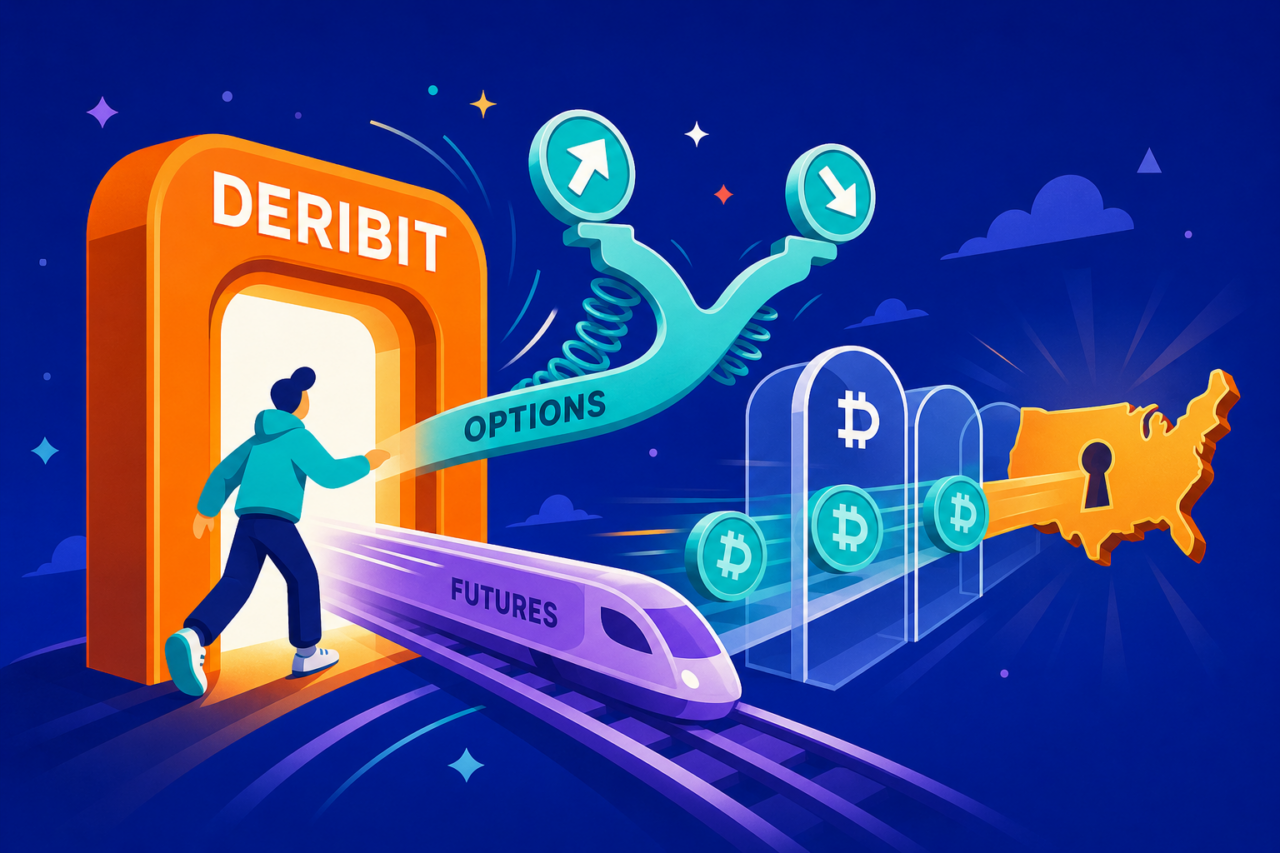
Deribit is a cryptocurrency derivatives exchange which allows trading of Bitcoin and Ethereum options, futures, and perpetuals. It is not a platform to go to for regular cryptocurrency purchases.
In short: Deribit is a platform which provides eligible users with access to Bitcoin and Ethereum options and futures, including perpetual futures contracts. These derivative products are traded on margin and some may allow leverage, meaning losses can accumulate quickly and positions may be liquidated. US users should expect certain regional restrictions. Since August 2025 Deribit has been part of Coinbase; check the current account rules for your country before you sign up.
What Deribit Offers Traders
Deribit is a third party cryptocurrency derivatives exchange. This means instead of simply buying and holding BTC or ETH directly, you are trading derivative contracts based on those assets.
This means that everything about the way you trade, your risk, and how the contracts are settled will be different to simply buying and holding crypto.
The platform offers a range of derivatives which includes:
- Options on Bitcoin and Ethereum
- Futures contracts
- Perpetual futures contracts (no expiry date)
- Derivatives trading on margin
- Settlement of contracts based on individual terms
Deribit is generally for people with an understanding of derivatives, collateral, volatility, order execution, leverage, and liquidation. It is not necessarily the type of platform for someone who simply wants to buy crypto and hold it.
Deribit Options And Futures Explained
At their core, options and futures are derivative products which are based on the performance of an underlying asset. Deribit allows trading of both.
A futures contract allows the holder to enter into an agreement on the basis of a future settlement. Perpetual futures are similar but do not have a fixed expiry date. Funding payments are made in order to ensure the price of perpetual contracts is pegged to the price of the underlying market.
An option contract gives the holder the right, but not the obligation, to buy or sell an underlying asset for a certain price. The seller of the option contract is obliged to honor the option if the buyer decides to exercise it.
Call option: Gives the holder the right to buy at a certain price, also known as the strike price. This is usually a fixed expiry option. The buyer will be at risk for the option premium, whereas the seller may be at risk for significant losses.
Put option: Gives the holder the right to sell at a certain price, also known as the strike price. This is usually a fixed expiry option. The buyer will be at risk for the option premium, whereas the seller is responsible for the margin on the option.
Futures: An agreement to buy or sell the underlying at a set price on a set expiry date. Unlike an option, both sides are obliged to settle. If trading on margin or with leverage, the futures contract may allow for substantial losses to accumulate quickly.
Perpetual futures: Futures style contracts but without an expiry date. Funding payments are made to ensure the price of the contract is pegged to the underlying market. As with all futures contracts, liquidation is a significant risk.
The maximum amount at risk on an option contract for the buyer is generally limited to the option premium, not accounting for other costs. In the case of an uncovered options seller, risk may be substantially higher and additional collateral may be required.
How Crypto Options Actually Work
The terminology surrounding options can seem complicated at first, but the basic idea is quite simple.
A call option gives the holder the right to buy the underlying asset at the strike price whereas a put option gives the holder the right to sell the underlying asset at the strike price. In both cases, there is an expiry date for the option contract and a premium that must be paid to purchase the option.
For example, imagine a call option on BTC with a strike price of $70,000 and an expiry date sometime in the future. If the price of BTC rises above that strike price, the value of the call option will rise. If the price of BTC does not rise, the option contract may expire worthless.
This is a simplified explanation and does not consider other variables such as implied volatility, time decay, premium paid, settlement of the contract, fees, and time to expiry.
- Strike price: The agreed price for the underlying asset that the option contract will be valued at.
- Expiry: The date and time at which the option contract will expire or settle.
- Premium: The amount paid for the option contract by the option buyer.
- Time decay: The amount of time value that expires as the option gets closer to its expiry date, all other variables remaining equal.
An option can move in the expected direction but still lose value if the move is not big enough or does not occur fast enough. This is why option trading involves much more than a simple bullish or bearish view.
Availability And Regional Restrictions
Can I use Deribit in the US? US persons should generally expect that they will be subject to regional restrictions, based on Deribit’s own regional restrictions. Whether or not a user is eligible will depend on residency, citizenship, account information, and other compliance requirements.
Access rules are subject to change and before registering an account with Deribit, you should check their list of restricted jurisdictions, terms, and conditions. These may also apply to specific products.
Users should not provide inaccurate information or use technical methods to get around location-based restrictions, as this may result in account, withdrawal, and other compliance issues. The fact that you can access a website does not necessarily mean that a product is legally or practically available in your location.
Deribit Fees And Trading Costs
Deribit charges fees on trading. These vary based on the type of product, order type, settlement, and other terms. The official fee schedule is available and should be checked for the most up to date information on Deribit’s fees.
When estimating the cost of trading on Deribit, consider:
- Trading charges when opening and closing a position
- Different rates for takers and makers
- Settlement/delivery charges (if applicable to the option you are trading)
- Funding payments on perpetual futures
- Withdrawal costs
- Bid-ask spread
- Slippage
Remember, low commission does not necessarily mean low costs. Trading frequently or with a high spread can be very costly. Slippage and funding payments can also add to your costs.
Margin And Liquidation Risk
Margin is the collateral you put up to open and maintain a position on a derivatives exchange. Using leverage allows you to control a larger position while tying up less collateral in your account. However, using leverage will amplify the impact of small market moves.
If your account’s equity falls below its maintenance margin requirement, your position may be liquidated by the exchange. There are a number of factors that impact liquidation, including the maintenance margin requirement, mark price and available collateral. The price at which liquidation takes place may differ from the last traded price.
Before using leverage, always make sure you understand your exposure to liquidation risks, including:
- The differences between initial and maintenance margin requirements
- The difference between mark price and last traded price
- The impact of funding payments on perpetual contracts
- Cross and isolated margin settings
- What may happen under fast-moving market conditions or in thin markets
Derivatives are high risk products and you can lose a significant portion, if not all, of the collateral allocated to them. Leverage can exacerbate the impact of adverse price moves.
Coinbase Acquires Deribit
Coinbase announced a deal to acquire Deribit in May 2025 and completed it in August 2025, adding Deribit’s options business to its derivatives lineup.
The change of owner does not by itself change who can open an account or which products are offered in your region, so check Deribit’s current terms rather than older reports.
Deribit Review – The Pros And Cons
Deribit is a specialist exchange. If you’re primarily interested in BTC and ETH options, futures and perpetuals, you may prefer to use an exchange that focuses on derivatives.
However, the products on Deribit are complex, access may be restricted depending on where you are, and margin trading requires careful control of your risk.
Pros: Deribit focuses on derivatives trading, especially for BTC and ETH. It offers options, futures and perpetuals in one place. It has tools and features that allow advanced trading strategies and has a good track record in the crypto derivatives space.
Cons: Deribit isn’t ideal if you simply want to buy crypto. Its leveraged products can lead to rapid losses. It isn’t available in all regions and its fees, spreads and funding payments need to be carefully considered. Its options products can be overwhelming for newer traders.
All in all, if you’re an experienced derivatives trader who wants access to BTC and ETH products, is comfortable with quantitative trading or understands how options work, Deribit is a good choice. If you’re new to crypto trading or simply want to hold crypto without leverage, you should consider other exchanges.
Practice Trading Derivatives With BuyCrypt
If you’d like to practice trading futures without depositing any funds into a trading account, try BuyCrypt’s crypto trading simulator. BuyCrypt also hosts free crypto trading tournaments and crypto demo trading contests with real market data. On BuyCrypt’s platform, you can trade a simulated balance and participate in competitions for real USDT prizes, without having to deposit funds.
BuyCrypt is not a cryptocurrency exchange and does not sell cryptocurrency. Beyond tournaments, BuyCrypt runs a crypto prop firm: prop plans start from 49 USDT, or you can earn a seat for free through the tournaments of The Ladder, on the way to an evaluation for a $5,000 funded account with an 80% profit split and USDT payouts confirmed on-chain. Nothing here is guaranteed.
Try our crypto trading simulator, view our free crypto trading tournaments, and check out our guide on futures vs spot crypto trading competitions. For information on how to prepare for crypto trading competitions, see our guide to risk management for crypto trading competitions.
Deribit has also held some crypto trading competitions. Check out our article on the Deribit and SignalPlus trading competition with a $450,000 prize pool.
FAQs About Deribit
What is Deribit used for?
Deribit is a crypto derivatives exchange used to trade options, futures and perpetual futures with an emphasis on BTC and ETH.
Are Deribit options suitable for beginners?
Usually not. Options involve numerous complex elements including the option premium, strike price and expiry date, and the impact of volatility and time decay on the option price. We recommend that you learn about options trading through education and simulated trading before considering trading on Deribit.
Is Deribit available in the United States?
US persons are generally not able to access Deribit. See Deribit’s terms and conditions for information on the jurisdictions where trading is restricted.
How does Deribit charge its fees?
Deribit’s fees depend on a number of factors, including the product you are trading, the type of order you are placing, whether you are settling or delivering an option and other terms that apply to your account. There may also be costs associated with the bid-ask spread, slippage and funding payments on perpetual futures. There may also be costs associated with withdrawing from the exchange.
Did Coinbase acquire Deribit?
Yes. Coinbase announced the deal in May 2025 and completed it in August 2025. Products and regional restrictions can still change, so check Deribit’s current terms.
Discussion
Comments from BuyCrypt Live. Sign in with Google or Apple — we create your BuyCrypt account on the way, the same one as in the app.