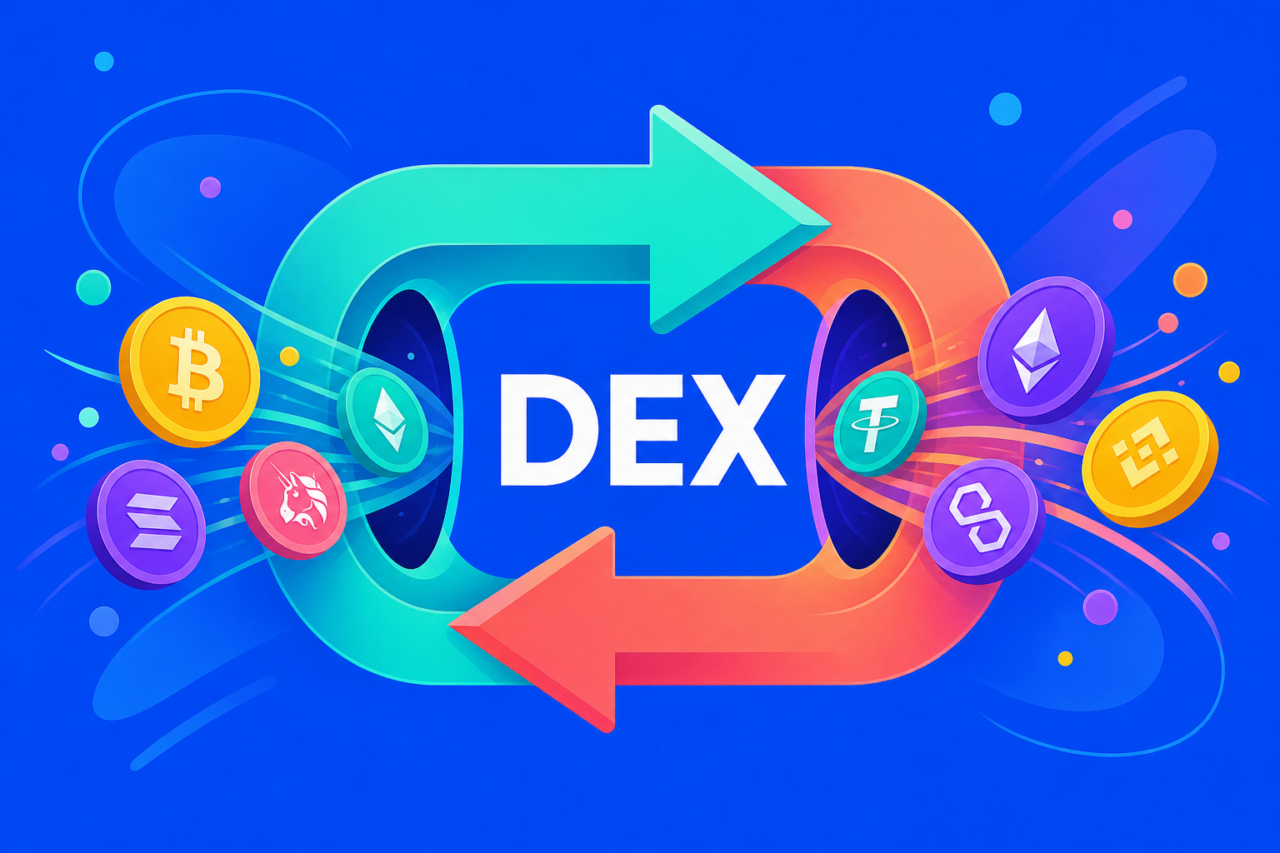
A DEX crypto allows you to trade and swap without relying on centralized services, while retaining custody of your funds. You trade and swap directly on the blockchain using your wallet. A CEX allows you to trade and withdraw your crypto assets with relative ease. The choice between the two options will come down to your experience, risk tolerance, goals, where you live, and how comfortable you feel using a particular platform.
DEX vs CEX: Understanding The Difference
On a DEX, or decentralized exchange, you trade using smart contracts from a non-custodial wallet. You simply connect your wallet to the DEX, choose your trading pair and approve your trade, which is then executed on the blockchain.
A CEX, or centralized exchange, is an exchange that holds customer assets in accounts on the exchange. Users deposit assets onto the exchange, trade on the order book, and then can withdraw their crypto assets from the exchange.
When using a DEX, you are subject to potential risks such as smart contract bugs, fake tokens, errors in your wallet, gas fees and low liquidity. On a CEX, you are exposed to other risks, such as the risks of custody, accessing your account, getting your funds out, the exchange, and regulatory risk.
Trading: How It’s Different on a DEX and a CEX
Trading on a DEX can be quite different from trading on a CEX. A DEX will use an automated market maker, or AMM, which matches buyers and sellers through liquidity pools. The pools set prices based on a mathematical formula. On a CEX, buyers and sellers are matched through an order book.
When you trade on a DEX, you are interacting with the blockchain through your wallet by signing transactions. On a CEX, trades are executed on the order book of the exchange and your crypto assets are held on the platform until you withdraw.
| Feature | Decentralized exchange | Centralized exchange |
|---|---|---|
| Setup | Connect a compatible wallet | Create and verify an account |
| Custody | You control your private keys | Assets are typically held by the platform |
| Trading system | AMM or on-chain order book | Traditional order book |
| Costs | Fee, gas, price impact | Maker/taker fees |
| Identity verification | May be limited | Usually required |
| Risks | Smart contracts and user error | Custody and platform risks |
A decentralized exchange may also offer access to assets or networks that are not available on a centralized exchange. However, it will be up to you to perform due diligence on the contract or tokens you wish to trade.
Crypto Custody and Control
One of the primary differences between trading on a DEX and a CEX is the custody of your crypto. On a DEX, you will be in control of your private keys. This also means that you will need to protect and manage your seed phrase, wallet address, transactions, and overall wallet security.
This does give you control over your assets, but it also means that if you lose your seed phrase, you may lose access to your crypto.
On a CEX, you will not need to deal with private keys. The exchange will manage the custody of your assets, while you will be responsible for your password, 2FA, and account recovery.
- Always ensure that you are sending funds to the correct network and wallet address
- Consider sending a small test transaction to a new wallet or platform
- Always check token contracts and liquidity before trading a new token
- Store your recovery phrases in a secure place and do not share them
Liquidity and Fees on DEX vs CEX
The trading volume or liquidity of the crypto market can have a big impact on how your trade gets executed. Markets with high liquidity tend to have tight spreads and lower price impact.
On a DEX, you may be exposed to trading fees, which may include a DEX fee as well as gas fees. You may also be exposed to the price impact of your order on the liquidity pool. For example, if you try to trade a large amount in a thin market, the price can move significantly against you.
On a CEX, you are likely to be charged a maker/taker fee, which is a fee for either providing liquidity or taking liquidity, respectively. Fees vary by exchange, and can also vary based on volume, account level, and the market in which you are trading.
Slippage can be an issue when trading on a DEX or a CEX. When placing a market order, your trade may fill at different prices. If you use a limit order, you can control your price, but you may not get a fill.
KYC, Privacy, and Regional Differences
Different crypto exchanges have different KYC (know your customer) requirements. A centralized exchange may require you to submit a range of information, such as government ID, proof of address, etc., before you can deposit, trade, or withdraw. This is part of regulatory compliance, and may take some time.
A DEX does not typically require you to set up an account. You can simply connect your wallet and start trading. However, keep in mind that all transactions on the blockchain are public, and your wallet activity can be analyzed.
The availability of a particular DEX or CEX will depend on your location, as well as the assets and networks they support. If you are considering using a DEX or CEX, be sure to check their current rules and regulations for your location. Do not transfer funds until you are sure of the rules.
Which Model is Right for You?
When choosing between a DEX and a CEX, you should consider what you want to do and whether that is the most appropriate solution, regardless of what is fashionable at the time. Your technical ability, custody preferences, need for liquidity, and ability to withdraw crypto are all important considerations.
Choose a DEX if:
- You want to have access to a particular crypto token or network on the blockchain.
- You know how gas fees work, how to approve transactions on a wallet, and understand the risks associated with using smart contracts.
- You’d rather not give up custody of your funds to an exchange.
Choose a CEX if:
- You’re more comfortable with the order book interface of a CEX.
- You find it easier to deposit or withdraw to a CEX.
- You’d prefer customer support and account recovery options.
- You want to learn the basics of crypto trading before dealing with the complications of wallets and custody.
However, many traders use both, for example, using a CEX to get exposure to a particular token and then withdrawing it to a wallet to take custody or trade on the blockchain. When transferring crypto from one account to another, make sure you are careful!
Practice Trading Without Risking Money
Trading with real money can be expensive if you’re not careful. However, practicing in a simulated environment can be a useful way to hone your skills, such as understanding how to use different types of orders, position sizing, spreads, and how to control your risk, without putting your own money at risk.
BuyCrypt provides free cryptocurrency trading tournaments. You can take part in demo trading competitions where you can trade with real market data, compete with your simulated balance and even win USDT prizes without depositing funds.
BuyCrypt is not an exchange where you can buy or sell cryptocurrency. It also doesn’t provide exchange withdrawals or direct access to a DEX. It is an educational and gamified trading platform where you can practice crypto trading in the form of a trading competition before putting real money into the market.
In a simulated trading environment, you can try out how well you handle price volatility, slippage, and whether you can follow a trading plan. However, there are elements of real trading that can’t be simulated.
Access Three Exchanges in One App
It can be difficult to manage accounts on multiple exchanges. However, using a multi-exchange crypto trading app, you can access all the markets of supported exchanges in one application.
For example, an app that supports Binance, Bybit, and OKX lets you easily compare trading pairs across different exchanges and manage your trades in one app.
Before using a multi-exchange trading app, you should check what permissions it has to access your exchange accounts and whether it has the ability to withdraw from them. Using separate API keys to connect to each exchange, turning on 2FA, and carefully reviewing the fee and regional structures is a must.
How BuyCrypt Crypto Trading Tournaments Work
In BuyCrypt’s trading tournaments, you use simulated trading accounts, but you are trading with real market data. You participate in an eligible free trading contest and are given a demo trading balance. You then follow the rules of the tournament to compete in the contest.
Depending on your performance in the competition period, you may win prizes. However, the conditions for prizes, the scoring system, and the available markets can vary. It’s important to read and understand the rules of each tournament before participating.
- Find an eligible free trading tournament.
- Review the rules, the scoring system, and the conditions for winning.
- Trade using the simulated trading balance.
- Review your trading decisions and how you did in the competition.
BuyCrypt’s free tournaments allow you to compete without having to deposit funds. However, it is important to note that winning prizes in the tournament is not guaranteed.
DEX Crypto vs CEX in 2026: Which Should You Use?
DEXs provide you with control over your own funds and access to crypto networks. CEXs are more convenient and provide you with bigger markets and easier account access. If you’re not sure which one you prefer, learn the ropes in a simulated environment, and then decide which exchange best suits you based on custody, fees, liquidity, security, and your location.
FAQs on DEX Crypto vs CEX in 2026
Is DEX crypto safer than CEX?
No, it’s not inherently safer. A DEX does take away some of the risks of using a CEX by putting you in control of your wallet. However, you need to ensure that you keep your wallet secure and are aware of the risks of interacting with smart contracts and the tokens you’re trading. A CEX may provide better support and security for your account, but you then put yourself at risk of losing funds to the CEX.
Do I need to do KYC to use a DEX?
You don’t have to do KYC to use a DEX as you are connecting your wallet to the exchange. However, your transactions are public on the blockchain, and you may still have to do KYC on the other services that you use. Regulations and policies may vary by region.
Are DEX fees cheaper than CEX fees?
It depends on the specific situation. It may depend on the network you’re trading on, the pair you want to trade, the amount you want to trade, and market conditions. Trading on a DEX, you pay gas fees and the fees of the DEX pools. When you trade on a CEX, you’ll be charged maker or taker fees. You should compare the fees in the context of the trades that you want to do.
Can I practice trading on a DEX or CEX for free?
You can practice trading on a simulated environment on BuyCrypt. BuyCrypt provides free trading tournaments and demo trading contests where you can trade with real market data and even win USDT prizes, although it is not an exchange, and you can’t buy or sell crypto.
Should I use a DEX or CEX if I’m just starting out?
A CEX is probably easier as they have a more familiar trading interface, with a similar order book layout, and provide account recovery if you lose your password or access to your account. A simulated trading contest can also help you get a feel for how crypto trading works before you take control of your own wallet and start executing trades on the blockchain.
More from BuyCrypt: all your exchanges in one app · App · play a free tournament
Discussion
Comments from BuyCrypt Live. Sign in with Google or Apple — we create your BuyCrypt account on the way, the same one as in the app.